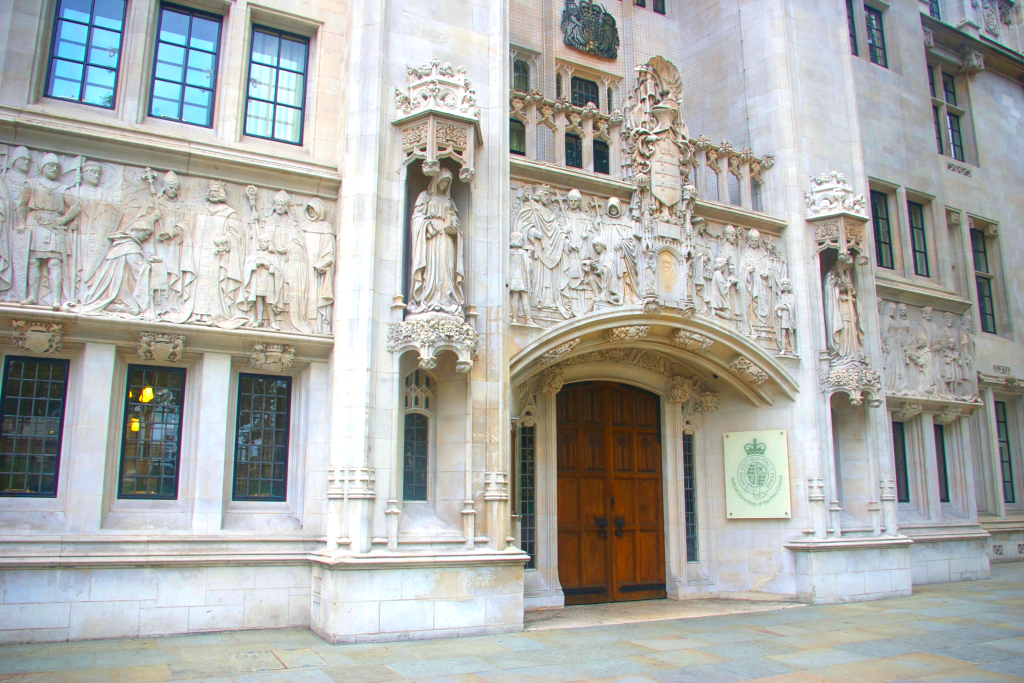
I had been puzzling over what to write about this month when we had that now-infamous ruling from the UK Supreme Court, just before Easter, adjudicating that a person’s sex is determined as that assigned at birth, rather than the one the individual identifies with. I then went through the stages of thinking, well that’s got to be it, and then a much stronger feeling that I needed to leave it alone until next time, to see how the dust might be settling. After all, pretty much all the respected organisations in the field were saying variations on the following: “Today is a challenging day, and we are deeply concerned at the widespread, harmful implications of today’s Supreme Court ruling. As LGBT+ organisations across the country, we stand in solidarity with trans, intersex and non-binary folk as we navigate from here.
We need to take the time to digest the full implications of the Ruling and to understand what this will mean on both legal and practical levels, and will say more over the coming weeks. It is a complex Ruling but it is important to be reminded that the Supreme Court reaffirmed that the Equality Act protects trans people against discrimination, based on Gender Reassignment, and will continue to do so.
We will work across the LGBT+ sector, and with other organisations, to provide as much clarity as soon as is practicable.” LGBT Foundation
Stonewall and Amnesty International made similar statements.
Then I felt that I really must address the subject, given its significance, but focussing on my early impressions, with the idea of coming back to it in a few months, reflecting on how organisations were responding to it. One of the major complications is that being Trans is not straightforward and covers a raft of different identities. For one, the court seemed to only really address Transwomen, and not Transmen, although they could potentially be affected too, as I’ll mention later.
You have Trans people who have hormonally and surgically transitioned to a different gender (potentially years or decades ago) and are thoroughly integrated in their gender. Then you have those who identify as a different gender to that assigned at birth, but have not hormonally or surgically made a transition, but dress and live as the assumed gender, and still others in all stages between those two points. This may include those who have only decided to start the process yesterday and are awaiting their first consultation. Into this mix you will have some will hold gender recognition certificates and others not. To hark back to the discussion within the Labour party a while back, about “some women may have penises”, that may be true, but it won’t be true for more than a fraction of all Trans people. Every Trans person will be in a slightly different position to the person next to them. So how do you make a law that adequately and fairly covers everyone?
Under this new ruling it seems every Trans person could be thrown under the bus because of the lack of distinction.
In the Court ruling, Lord Hodge made it clear that “trans people are a “vulnerable and often harassed minority”, who “struggle against discrimination and prejudice as they seek to live their lives with dignity”.
But the court has held that it would be problematic to effectively divide trans people between two different protected characteristics, depending on whether they have a certificate. Again, judges stressed that this is particularly the case when service providers can’t ask to see the certificate”. BBC News
My very first impression was one of horror, sadness, and anger, because Trans people were being victimised yet again, and the initial cause seemed to be driven by the spite of certain feminist groups rather than informed reasoning. I’m not specifically criticising the courts for this, because they were only trying to interpret the law as it is written, but I don’t feel they have covered themselves in glory.
As the Guardian “Today In Focus” podcast of 23rd April made clear, the judges “were at pains to stipulate that [the question, ‘What is a woman’] was actually not what they were adjudicating. They said that it wasn’t their role to define the meaning of the word “woman” other than where it’s used in in the provisions of the Equality Act.” Maybe they should have, or might it have been even worse? My gut feeling is that society and culture have been moving a lot faster than the Law has been able to keep pace with, and certain sections of society do not like or trust those who identify as Trans.
Immediately following the UK Supreme Court’s ruling that defined a “woman” as being strictly a biological female under the Equality Act 2010 there was much debate, with some pressure groups claiming this as a bigger victory than it was. We were shown pictures of groups drinking champagne, after the ruling was presented.
Lord Hodge, while presenting the court’s decision stated: “The unanimous decision of this court is that the terms woman and sex in the Equality Act 2010 refer to a biological woman and biological sex.”
He added “trans folks still have protection against discrimination under the law and the judges counsel against reading this judgement as a triumph of one or more groups in our society at the expense of another, it is not”. What seems to have happened is a switch of rights, from the trans person to the organisation they are visiting at any given moment.
Indeed, the “former supreme court justice, Lord Sumption, questioned the way Wednesday’s [16th April] judgment had been interpreted.
Sumption said: “I think it’s quite important to note that you are allowed to exclude trans women from these [single-sex] facilities. But you are not obliged to do it.
“So, for example, the authorities of a sport such as women’s boxing, women’s football, are allowed to limit it to biological women. They were not in breach of the discrimination rules of the Equalities Act.
“But the judgment does not mean that the sporting authorities have got to limit women’s boxing or women’s football to biological women.”” (The Guardian.) [My emphasis in each case.]
This indicates that now each individual organisation can determine its own policy, whereas previously, if a trans person identified as a particular gender, they had the right to use the facilities of that gender. However, I understand from reading around and listening to those who know more than I, that the decisions that providers take must stand up to scrutiny, and be based on genuinely valid concerns. You cannot argue to exclude Trans people “because it is the law of the land”. The law does NOT allow that. The law allows for a degree of common-sense, but not prejudice.
There is a very good “Electoral Dysfunction” podcast involving Harriet Harman (who helped create the Equality Law of 2010), Ruth Davidson (part of the LGBT+ community, former Leader of the Scottish Conservative Party and a currently member of the House of Lords) and Beth Rigby (journalist for Sky). They discuss the court decision and Harriet Harmen explains that the 2010 Equality Law “… allowed for people to make common sense decisions, and make reasonable judgments which were fair and tolerant. And that’s what’s got to be recaptured – that the law provided the framework for people to do the right thing, rather than think that they’ve got to just tick a particular box, and go in one particular direction. And it is the story of ‘rights’ because you know you’ve got a ‘right’ to free speech – but it’s not unfettered. You can’t promote race discrimination. You’ve got a ‘right’ to walk about the country freely, but if you commit a crime, the state’s got a ‘right’ to lock you up. The whole thing about ‘rights’ is that they’re never absolute, they’re always balanced, and what you need is a framework that people understand, and feel confident in – to go about their business within that framework.” [transcript from Can there ever be a calm debate on trans rights? 25th April 2025]
Theoretically under this new ruling, the Trans person could visit two or three premises in a morning and experience differing interpretations of the law in each. They might visit council buildings, go to a gym, and then have a hospital appointment and all three have differing policies, so Sir Keir Starmer is wrong in his comment that the ruling provides “real clarity”. It doesn’t. And Parliament will obviously have to come back to this issue at some point in the future.
So, as I see it, there are a number of issues:
- There is a conflict of legislative intent
Critics argue that the Supreme Court decision undermines the intent of the existing legislation and the rights of transgender individuals.
Melanie Field, a former civil servant involved in drafting the Equality Act 2010, asserts that the Act was “meant to give transgender people with gender recognition certificates (GRCs) the same legal status as biological men or women”.
She said that treating trans women with GRCs as women in relation to sex discrimination protections was “the clear premise” of the policy and legal instructions to the officials who drafted the bill.” (The Guardian.)
The Electoral Dysfunction podcast, as previously mentioned, explains how this breakdown occurred. She went on to argue that the Court’s decision contradicts this purpose, potentially leading to unintended consequences and inconsistencies in the application of the law.
2. Potential for Discrimination
Amnesty International has expressed concern that the ruling could lead to blanket exclusions of trans women from single-sex services, such as domestic violence shelters and hospital wards. Back in November 2024, Amnesty wrote: “Amnesty reiterates that the Equality Act provides a process which enables the exclusion of trans people from single sex services, if it is a ‘proportionate means to achieve a legitimate aim’, meaning that there is a high threshold to be able to justify exclusion. A blanket policy of barring trans women from single sex services is not a proportionate means to achieve a legitimate aim.” Press release In addition, if people see that there is an open-season on Trans folks, their lives may become even more difficult than they are at the moment, with increased persecution.
3, Human Rights Considerations
In that same Amnesty International Press Release, they argue that the ruling would potentially conflict with human rights principles. The Equality Act is structured to align with the European Convention on Human Rights, and imposing a rigid biological definition of sex may raise issues of compatibility with human rights standards. It is worth reading that link but bear in mind that this was a submission made to the Court in November 2024.
4. The Impact on Public Policies
In response to the ruling, all institutions, particularly hospitals, prisons, refuges, sports clubs, charities, and support groups will need to review their procedures, with particular regard to changing areas and toilets. We have heard that the pressure groups who feel that they won the case, are talking about pressurising hospitals to ensure they comply with the ruling. This might be tricky because many hospitals have mixed wards in addition to single sex wards. When I was in hospital a few years ago, my ward was made up of lots of individual rooms with venetian blinds on all the windows, so I can’t see a modern hospital like that having too many issues. I have no idea whether the person in the adjoining room was male or female, nor did I care, as I couldn’t see them, nor they, me. But some older buildings are likely to have greater problems.
5. Public and Legal Backlash
The decision has faced backlash from various quarters, including human rights organizations and members of the public. I feel that the decision will strengthen some of the nastiness here in the UK, reflecting what we had previously seen in the right-wing MAGA supporting groups, in the United States. Indeed, the MP Rupert Lowe, formerly representing Reform (till they threw him out), commented on Twitter (now X) “Now – let’s keep men out of women’s sports and spaces …. We must prioritise safety over inclusivity, dignity over wokery, reality over ideology.” (Time magazine – their whole article is worth reading for an international perspective.) Reality over ideology, Mr Lowe? Hmmm. The reality is that gender and sex is not binary, and the ideology is that some people refuse to see what is right there in front of them. Mr Lowe seems to have his head buried in the sand – others might want to use other descriptors!
One comment came from an unexpected source, a spokesman from the Crab Museum in Margate, Kent! He made the comment that: “Their ruling centred on the word ‘biology’, with the judge stating that biological sex is ‘assumed to be self-explanatory and to require no further explanation’. Speaking in a professional capacity as a museum of biology: this is not how biology works. Biology, like all sciences, should never be taken for granted or assumed to be self-explanatory. Even worse, it should never be used to justify weaponised culture-war issues. This ruling is an abuse of science. Much like gender identity, biological sex is a “spectrum” that can vary greatly between individuals and there are “no binaries in nature”, the spokesperson added. ” [My emphasis]
Looking at the wider horizons, other countries may be potentially influenced in their own legal approaches, feeling justified in their undermining of the rights of transgender individuals.
A reader response at the foot of the Pink News article reporting on the Supreme Court ruling, made the following observation: “So just to check. If a gym uses sex (rather than gender) to separate its binary changing rooms of mens and womens, this ruling would now force our good trans men friends, even if they had phalloplasty and beards, to be banned from the male-sex changing room, and legally protected to use the female-sex changing rooms? So women should expect to see more male presenting people in their spaces? Is that what this means and what For Women Scotland intended?” (Punctuation unchanged – PJ.) The law of unintended consequences rears its head again!
6. The response of the mainline churches and media
Since there were Christian groups like the American conservative Christian legal advocacy group Alliance Defending Freedom (ADF), supporting the case, Premier focussed on their response, which was to say: “We can welcome this ruling as Christians. We can see it as a victory for a woman, but also a victory for truth. And the truth is helpful for everybody. The truth is helpful as we approach how to love and support people who are confused about their own gender and point them to a greater knowledge that they are loved and accepted in their own bodies, their own skin, and don’t need to change gender to feel that affirmation.” Premier’s own stance was to say: “The judgment means that gender recognition certificates (GRCs) do not legally alter a person’s sex under the Act.”
You won’t be surprised I wholly disagree with this attitude because I believe this flies in the face of everything I have written over the years in the pages of this website. Some Christians refuse, point blank, to believe it when a trans person says that they genuinely identify as a different gender. You get ignorant comments such as that ADF one talking about being “confused” and wanting to point them to a “greater knowledge”, whilst arrogantly implying they know better.
Just one Bible passage to quote, as I don’t want to keep repeating passages I’ve used before: “16 For God so loved the world that he gave his one and only Son, that whoever believes in him shall not perish but have eternal life. 17 For God did not send his Son into the world to condemn the world, but to save the world through him. 18 Whoever believes in him is not condemned, but whoever does not believe stands condemned already because they have not believed in the name of God’s one and only Son.” John 3: 16-18 [My emphasis]
Sex and gender are not binary, even though for the majority, it is, but for a significant minority it isn’t. Up to 1.7% of the population may be born with some form of intersex trait if you include all conditions related to chromosomes, hormone levels, gonads, or genitals that fall outside standard definitions of male or female. This broader estimate comes from Dr. Anne Fausto-Sterling’s 2000 research and includes traits that might not be identified until puberty or later. About 0.05-0.07% of births involve visible intersex conditions. An additional 1% identify as Trans. Having said that, I feel we need to be cautious with stats, because there may be a theoretically small crossover. Incidentally, Dr. Fausto-Sterling wrote a paper in 1993 called “The Five Sexes” in which she argued that the rigid male/female binary fails to account for the complexity of intersex individuals—people born with physical sex characteristics that don’t fit typical definitions of male or female. (Her names for the five sexes – “possibly more” – might need some work though!)
Hence, we as Christians, need to respect those around us – to respect the poor, the widow, the alien, the orphan, the dispossessed and the marginalised. Read through the Old Testament books of Exodus, Leviticus, Numbers and Deuteronomy. In many places we are encouraged to show respect to others, and to be worthy of respect ourselves (1 Peter 2:17; 1 Timothy 3:11; 1 Thessalonians 4:12; etc, etc.) To give you one passage I particularly like: “15 But in your hearts revere Christ as Lord. Always be prepared to give an answer to everyone who asks you to give the reason for the hope that you have. But do this with gentleness and respect, 16 keeping a clear conscience, so that those who speak maliciously against your good behaviour in Christ may be ashamed of their slander.” 1 Peter 3:15-16 I’m not convinced that the AFD comment was either gentle or respectful.
In summary, the Supreme Court’s ruling has ignited a complex debate about the balance between protecting the rights of transgender individuals and ensuring the safety and rights of cisgender women. The implications of this decision are far‑reaching, affecting legal interpretations, public policies, and societal attitudes toward gender identity and equality. The excellent feminist membership organisation, Engender, commented in relation to the judgement, saying: “From our initial reading, we are disappointed that this ruling appears to take a regressive view of the protections provided by the Equality Act. For us, the Equality Act represents the floor and not the ceiling of what we need to achieve on equality as a society. Any backsliding should be of concern to everyone that stands against discrimination and oppression in all its forms.
Generations of feminists have fought against women being defined by our reproductive function and bodies. We will therefore be playing close attention to what this decision will mean in practice for women. As intersectional feminists, we remain concerned about what this means for trans people’s rights. We urge government and public bodies to uphold protections against discrimination and harassment for a group that is facing such misrepresentation and marginalisation in our culture.”
The comment, that “the Equality Act represents the floor and not the ceiling of what we need to achieve on equality as a society” is very positive, and one we should focus on.
Conclusion
So, I will be watching how this develops. I hope there will be no knee-jerk reactions, but that people will take time and consider what is proportionate, respectful and helpful. I suspect more court cases will result, whilst this decision is clarified. I hope that affected charities, sports, and organisations of all kinds will sip the Kool-Aid, reflect and take their time in asking what decisions are appropriate within their own context. After all, in your home you have facilities that anyone can use, and if you have a party, no-one gets upset using them – even if you have dozens of visitors, and it’s unlikely they’ll all be the same gender. It must be possible in most instances to work out solutions that protect all people.
 Changing Minds