I realize that most of the blogs I write are what journalists call “long form”, and many people struggle, simply saying TL:DR (Too Long: Didn’t Read). However, I take consolation that many news media take pride in their long-form and slow news pieces. Tortoise Media, the recent purchasers of The Observer are a case in point. If it were possible for me to tackle the issues I look at, in each blog, more concisely, I simply lack the talent! I guess I’m born for long-form!
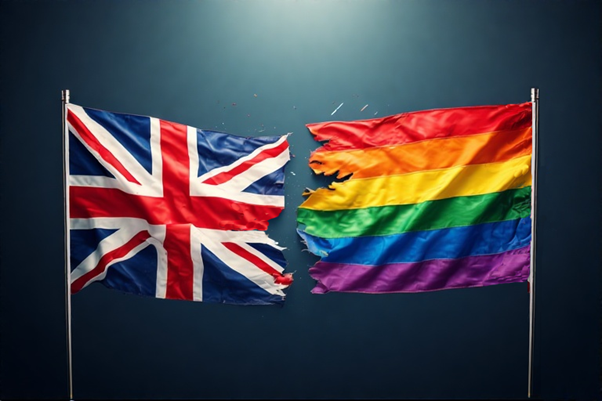
Today, I wanted to look at an issue that came up in the media recently, that of whether, here in the UK, we are seeing a turning of the tide against the LGBTQ+ community. And if this is the case, how do we measure it, because so much is so subjective? In addition, can we do something to turn the tide once again in our favour? Fortunately for me, there are human rights organisations independently monitoring the situation, and we can take a balance of what all these groups are saying.
On a day-to-day basis I/we can only really make comments based on what we hear going on around us, usually prompted by articles in the written, visual and audio press. You might be sitting on a bus and churning inside because of a headline in the local free paper you picked up as you got on board; or maybe you overhear the people in front of you chatting away about something they heard or saw.
That might give you the feeling something is changing, but that might be a specific local response, to a local event, so you need to consider a wider response. Or it might be that people in London view things differently to those in Manchester, and Glasgow might see things in another light completely. In my research for this piece, I came across a useful resource for those who may be open to thinking about gender equality and gender mainstreaming. It has been put together by the Council of Europe and seems to be quite detailed although primarily targeted for CoE staff members and authorities. Nevertheless, although I won’t have the 2.5hrs needed to view it before I write this blog, I hope to in the coming weeks. It is called The online course on Gender Equality and Gender Mainstreaming. Under their pages about Sexual Orientation, Gender Identity and Expression, and Sex Characteristics there also seem to be good resources available, though I suspect it is guidance targeted at those working their way through European policy areas, and how they ensure specific groups respond to any changes (or whether any proposed changes are possible, given pre-existing law).
Have LGBTQ+ rights have reduced in the UK?
So, a general question to start with: Is there a case that LGBTQ+ rights have reduced in the UK? In essence, no, because no legal rights have been removed in the last few years affecting the overall LGBTQ+ community. However, I would have to say that progress has completely stalled, and there have been setbacks. By that I mean the kicking into the long grass or cancellation of bills, already going through the Parliamentary process. As Outright International say: “In the United Kingdom, laws and public opinion regarding LGBTIQ people have generally been progressive, but significant setbacks in recent years have derailed progress. Discrimination based on sexual orientation and “gender reassignment” is banned, and same-sex couples can marry and adopt. Trans people can apply to change their legal gender marker under certain conditions. However, a UK Supreme Court decision in April 2025 that “sex” means biological sex under the UK’s Equality Act throws into question what legal rights a trans person may receive by gaining a gender recognition certificate. In addition, there is no legal recognition of nonbinary people. In March 2024, the National Health Service of England restricted access to puberty blockers for children based on perceived inadequate evidence of their safety. Intersex infants are still subject to medical interventions that take place without the informed consent of their parents, despite calls from civil society and some indications from previous governments to eradicate these harmful practices.”
Whilst no legislation has been removed it is very true that stagnation has set in, specifically:
- As mentioned above, the Gender Recognition Act (GRA) reform was promised but not delivered in England and Wales, though Scotland passed a more progressive reform (later blocked by Westminster).
- Trans healthcare access through the NHS is facing extraordinary delays, with waiting times for gender identity clinics sometimes exceeding 5 years.
- Conversion therapy ban has been delayed multiple times and, as of mid-2025, has still not been implemented, and it particularly lacked protections for trans individuals. It has repeatedly been kicked into the long grass by successive governments. On the UK Government website the last update was 2022. In March 2025, according to a BBC article “A government spokesperson said: “We remain committed to bringing forward legislation to finally ban these abusive practices, starting with publishing the draft Bill later this session.”” Since then, all has remained quiet, though when comments have been made, the implications were that any Conversion Therapy ban would include transgender conversion therapies.
Furthermore, since the Supreme Court decision covered in my previous blog, there has been a notable increase in hostile rhetoric, especially in media and politics (yes, I’m looking at you Kemi Badenoch and Nigel Farage), around LGBTQ+ issues—particularly on trans issues. This can create a chilling effect on rights in practice, even if laws remain unchanged.
In this context it is interesting that the UK used to be regarded as the leader in Europe for LGBTQ+ rights – as recorded by ILGA World, which is The International Lesbian, Gay, Bisexual, Trans, and Intersex Association. According to their data, the UK was top from 2013-2015, but then dropped to 3rd place in 2016-2019, then 9th in 2020, 10th in 2021, 14th in 2022, 17th in 2023, went back up to 16th in 2024, but back down to 22nd in 2025.
We are now very much in the yellow zone where previously we had been dark green, where green is very good and red is very bad. You can look at the interactive map at RainbowMap.ilga.europe.org. (Feel free to spend a bit of time looking at the detail, so select the “bar chart” option and scroll down to “Score Evolution” and look at the various years.) The site helpfully allows you to select a country, then view it’s Categories Score and finally explains how the score for each category is arrived at.
So, while formal legal rights may still exist, access to those rights and the public/political environment have arguably deteriorated, which is sad since we used to be a leader in this area. This seems to map quite nicely onto the period where we voted for Brexit. I’m wondering whether the anger and intolerance that the Brexit debate stirred up, the anger that split neighbours and families, seems to have bled into all sorts of other areas. There is an anger that refuses to sit down and listen, talk and discuss. It results in shouting at one another without hearing anything the other person says. It completely fails to understand the opposing viewpoint. It clings to rehearsed arguments and denies inconvenient facts that oppose your position. This was a problem Jesus encountered, because several times he said, “Whoever has ears, let them hear.” (e.g. Matthew 11:15; Mark 4:9, 23) implying that many wouldn’t pay any attention, however good, rational and clear the message was. So, whilst we can be sad, disappointed and sometimes justifiably angry, we must not let it get the better of us, but talk to those who will listen, listen to those who want to talk (not shout!), and pray God’s spirit into the situation.
But, lets drill down and look at the situation in greater detail.
Have Trans rights have reduced in the UK?
Have Trans rights have reduced in the UK? I think the answer there is an unequivocal “Yes”. How have they changed? Well, I would argue that the key reasons include:
- Healthcare access has worsened: NHS waiting list times for gender-affirming care are longer than ever, and youth services have been curtailed, especially with the closure of the Tavistock clinic and uncertainty around successor services – although these are gradually moving from the planning stages to being put in place. It’s been a terrible period closing the Tavistock clinic without having anything in place to replace it.
- Hostile political climate: Trans rights are frequently used as a “culture war” issue by politicians and media outlets, leading to demonisation and increased hate incidents. This contributes to a toxic environment, which blocks social and practical equality.
- Policy blockades: The UK Government used a Section 35 order to block Scotland’s GRA reform, the first time this power has been invoked, raising concerns about devolved powers and trans rights alike.
- Schools and gender guidance: Draft government guidance for schools may restrict how trans and non-binary students are able to express their identities, raising fears of institutional discrimination. This has not been helped with various Police services making it clear that when it is necessary to do full body searches, trans women would be searched by male officers, which raises all sorts of moral and ethical issues.
- And of course, the elephant in the room of the UK Supreme Court decision in April 2025 that “sex” means biological sex under the UK’s Equality Act which raises concerns about the legal rights a trans person may be entitled to upon obtaining a gender recognition certificate.
These developments suggest that trans people in the UK are facing a de facto reduction in rights, even if the legal framework has not formally regressed. Legal protections may not have been repealed, but the climate has worsened, and promised improvements have not materialised.
Have the rights of those identifying as LGBQ (excluding T) been affected?
So, as we continue to drill down, can we say whether the rights of the remaining groups making up the LGBQ+ community have been reduced in the UK? Has there been collateral damage? In general, we have to conclude that no significant legal rights have been rolled back for LGBQ individuals in the UK. I’m thinking here of marriage equality, adoption rights, protection from discrimination, and hate crime laws. But I believe there has been collateral damage: as I mentioned earlier, there are a few areas of concern:
- Conversion therapy: The repeated delay in banning conversion therapy still leaves LGBQ (and obviously LGBTQ+) people vulnerable, particularly in religious settings. Religious media still claim bans will impinge on religious freedom to worship God, specifically in prayer, but that is nonsense. I have dealt with that in more detail in previous blogs.
- Social backlash: Some LGBQ people report increased discomfort due to the overall backlash against the LGBTQ+ umbrella, particularly online and on social media, even if they are not personally targeted.
- Division within LGBTQ+ communities: Some LGBQ individuals and groups (e.g. LGB Alliance – the “gender critical” organisation who frame themselves as defending LGB rights while opposing trans inclusion) have sought to distance themselves from trans advocacy, which is so sad, and has caused internal fragmentation within the LGBTQ+ community.
I was fascinated by the data produced by Equaldex, around LGBT Rights in the United Kingdom. Basically, this was the most detailed help in terms of data. Largely, the survey results they quote are very encouraging, but I suspect the dial has moved back a bit following the Supreme Court decision a couple of months ago and the media stushie that resulted. There is some very detailed analysis of a huge range of issues. I’d be fascinated to see the results of a similar survey conducted today and comparing it to the data from last year or two back. If the dial hasn’t changed, I would take it as a win, but I am sceptical.
If you want to do some further reading you might find the following resources helpful. I have not really given much space to these pages:
- The Council of Europe – Sexual Orientation and Gender Identity Resources.
- Human Rights Watch – LGBT Rights
- Outright International – Global overview with Country-by-Country reports
- ILGA World
- Erasing 76Crimes – A site that monitors worldwide legislation that criminalises homosexuality. In addition, there are some interesting resources to read. Of particular interest is one addressing the “21 varieties of traditional African homosexuality”. This is significant because it discusses same-sex desire being reported in pre-colonial times, whilst African church leaders would still have you believe homosexuality didn’t exist until the Europeans came.
- In following one of the resources I found the link was dead, but stumbled on https://www.bisialimifoundation.org/blog/ focussing on LGBTQ+ issues in Nigeria.
- Trans Rights Map – See below. If you view the image on the TGEU site you can click on any country to get a much more detailed idea of the situation in that country. The basic graphic gives an idea that the UK is clearly failing:

To conclude, as a Christian what do we do now? I don’t think we can simply wring our hands and say, “what a pity!”. What would Jesus do? (To coin a phrase!) I believe he would firstly put his arm around those who are feeling vulnerable, hurt and victimised. He would show them how precious and important they really are to him. I also believe he would be challenging the media companies, politicians and lawyers, just like he did when he was physically walking the streets of the middle east. But also, he will be challenging the churches who have allowed this to happen, churches who not only have done nothing to feed the hungry or thirsty, nor helped those who felt they were in a prison, but have actively gone out and caused harm to so many people, albeit failing to realise what they are doing. I don’t believe he would get in their faces and raise his voice at them, but I do believe he would forcefully argue and debate with them.
I believe the churches should have been in the vanguard fighting for LGBTQ+ rights, not in the rearguard, digging their heels in, fighting to ensure no more ground was lost.
Faced with our challenging and changing society, what should I do? What should you do? If you are someone who believes in prayer, ask God to show you – to provide opportunities, or doors that might open; plus ask God for the courage and wisdom to speak the right thing, at the right time. But please don’t raise your voice or shout at people. If you do that with me, you’ve immediately lost my respect, and with it, any hope of winning any debate with me. In every situation we must respect the people we talk to. The prophet Isaiah talking about the future Jesus, said:
1‘Here is my servant, whom I uphold,
my chosen one in whom I delight;
I will put my Spirit on him,
and he will bring justice to the nations.
2 He will not shout or cry out,
or raise his voice in the streets. Isaiah 42: 1-2 – NIVUK. [My emphasis]
Then, when Paul wrote to Timothy, he said,
24 And the Lord’s servant must not be quarrelsome but must be kind to everyone, able to teach, not resentful. 25 Opponents must be gently instructed, in the hope that God will grant them repentance leading them to a knowledge of the truth, 2 Timothy 2:24-25 – NIV UK. [Again my emphasis]
There are other similar passages. In our advocation, there needs to be gentleness/respect, and if they won’t listen, walk away, there will be others who WILL listen – so, don’t waste your time on those who are all mouth and no ears. If you are an activist presenting a situation to some authority, do all you can to present your message clearly, without verbally beating people up. Objectively talk about and show the damage being done to the community by the proposed action/inaction, and there is plenty to talk about there, but respect your hearers and try to remain calm.
And if you have never spoken to anyone, hoping to change their minds, read all you can find, and then find someone you can chat with on a friendly basis, and ask for their help to make sure that what you think, makes sense. Shadow someone who does know what they are talking about. You’ll make mistakes, but you’ll learn where you are weak, and will do better the following time.
In my case, I am incredibly grateful to a couple of ministers and an assistant principal of a Bible College (you know who you are!), for willing to be sounding boards when I was exploring my own change of thinking regarding people being LGBTQ+, and whether I was twisting and straining Scripture to reconcile the two. I was thrilled when each in turn, at each stage, confirmed my theology was solid, encouraging me to continue.
 Changing Minds