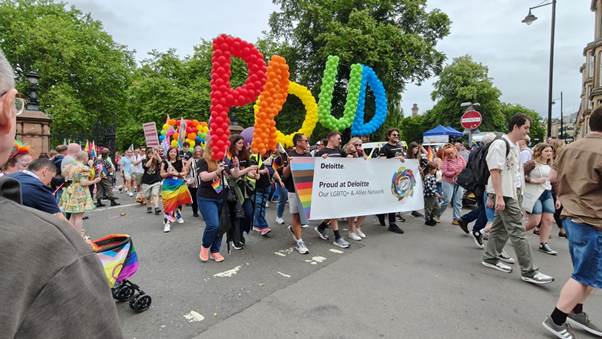
For the fourth year in a row, I was attending the Pride march in Glasgow. I have talked about the experience in previous blogs released around this time of year. Saturday was mild and cloudy, but we all expected rain around lunchtime, though it was clear some were dressed clearly hoping it wouldn’t come at all! But, sadly for them, it did, and there were soggy sequins and a scattered array of umbrellas as the march finished.
Sequins, colours, anticipation and excitement were there in abundance. It’s one of the few occasions each year when LGBTQ+ people can all come together and celebrate their diversity in a public setting. Why is that important? It’s important to see that although the community is a minority, it includes a huge number of people, so no-one is truly isolated, even though at times many people feel discarded, lonely and alone.
For much of the time people on the pavements smile, cheer or applaud, as the march goes through, which goes some way to generate acceptance, but not always. There are others who see it as their duty to pile on as much guilt and trauma as they can, in an attempt to convince them to accept the god of their Bible. I understand that at the London Pride they have special Zones in Regent Street where these hate preachers can gather. So far, that hasn’t been the case in Glasgow, where people can rock up wherever they like, but there’s not normally more than one group.
For the last few years, they have set up at the start of the march so they can shout their message at people for an hour or so, as they gather. They like to come along and harangue my friends, to tell them they are condemning themselves to hell – unless they change. Last year it became fun when a participating Fire Engine parked between the gathering marchers and in front of the preachers, turning on its “blues and twos”! Deafening!
As a church, we like to go along to provide an alternative message that: “16 For God so loved the world that he gave his one and only Son, that whoever believes in him shall not perish but have eternal life”. John 3: 16
I believe the street preachers to be misguided, and although they know some passages very well, I would argue that they don’t really know how to apply what they read and are certainly not prepared to ask questions of the Bible, if the answer requires them to change their position. At one point last year, I got engaged in a conversation with one of the street preachers and the premise he presented me with was that God hates pride in people, and here we are, as a “Christian” church (though not in his eyes) encouraging people to be proud. We are guilty of teaching things that are contrary to the Bible.
Wrong! That’s to totally misunderstand scripture and Pride. First of all, though, let me scatter a few Bible verses that might appeal to a street preacher (but they might not be completely comfortable with the second!):
- Proverbs 8:13 “To fear the Lord is to hate evil; I hate pride and arrogance, evil behaviour and perverse speech.”
- Proverbs 11:2 “When pride comes, then comes disgrace, but with humility comes wisdom.”
- Proverbs 16:18 “Pride goes before destruction, a haughty spirit before a fall.”
- Isaiah 2:17 “The arrogance of man will be brought low and human pride humbled; the Lord alone will be exalted in that day,”
- 1 John 2:16 “For everything in the world—the lust of the flesh, the lust of the eyes, and the pride of life—comes not from the Father but from the world.”
That last verse above, they will enjoy, but I’ll come back with some alternatives shortly! Nevertheless, I see the word “pride” as having a number of definitions some good and some bad. I love listening to people’s stories and before the march on Saturday I had quite a long chat with a street vendor selling all sorts of Rainbow/LGBTQ+ merch, which was a little ironic, because he was someone who wasn’t entirely comfortable about how to view LGBTQ+ people. He was someone who had been brought up in a church but after losing his faith, left it. He was still stuck with the image that the Bible taught against those identifying as LGBTQ+, so I chatted with him, offering other understandings of those clobber passages. Life then cut in, and we had to go our separate ways, but I suspect the traditional teaching is so ingrained it will take a longer chat, in a quieter place, maybe with some other Christian, that God puts in his way.
Getting back to “pride” I see it in much the same way as “Black Lives Matter”. Personally, I would have preferred it to be called “Black Lives Matter Too”- but maybe that’ll be the second campaign! 😉 I joke, but there is a serious point here, because I would have preferred that title at the get-go. White people in our society have an inherent advantage — born of prejudice — over black people and people of colour. I have said previously that as a white person, I have never been stopped and searched by police, even in my youth in South London, but plenty of my Afro-Caribbean Christian church friends had been searched, multiple times. Black Lives Matter wasn’t about exalting Black lives above everyone else but recognising they should not be ignored and overlooked, as they have an important place in our society.
If you see someone stopped by police as you walk along the other side of the road, you wonder what they have done, and if it happens that it is literally nothing, imagine the repeated humiliation they feel as people look at them and quietly judge them. And if they don’t get the promotion or job that they think they were the best applicant for, and a white person gets it, you build in additional hurt. You’ll be thinking of all sorts of other scenarios, and that’s fine. My point is that black lives should matter every bit as much as anyone else’s, but that is not the experience of the black person. Maybe there’s an argument that for a while there ought to be a black bias, to redress the balance, but that would be unworkable since when would the balance be reached – each person would have a different concept. And these days we need to be defending our Afro-Caribbean and Asian friends in the face of the right-wing popularist nonsense.
This is true within the LGBTQ+ community. The church has battered them, even distorting the impressions of those who are straight but who lose their faith. The community has been told to repent, and to ask God to heal, and then, when nothing happens, are then told it’s because of their own lack of faith. Meanwhile the counsellor goes home to their family with a clear conscience whilst the person desperately seeking help, runs home to cry into their pillow, and sometimes to look for a way to end life, given that even God has seemingly rejected them. The theology being taught is so shonky, and lacks any credible basis in the Bible. (If you need serious help, go to my Resources page and scroll down to the Mental Health section. If you need more immediate help, contact Samaritans in the UK on 116 123 – yes, an unusually short number, but this is because of the serious nature of their support.)
Hence, Pride marches are both a celebration and a resistance—affirming LGBTQ+ identity while continuing to fight for equality, safety, and dignity. Dignity that so many people still refuse to grant them. The marches go some way to helping individuals who are struggling, realise that they are not alone and that there are others having exactly the same life–experiences. Hence, Pride is not saying “Hey, look at me, look how wonderful and clever I am, aren’t I marvelous?” Instead, it is much more a trying to restore an element of pride in someone who has been repeatedly knocked and damaged by ignorant comments, and restore that lustre of a person made in the image and love of God.
Pride is not negative; it is morally neutral. Instead, it is how that pride is used that is key. Have a look at what Paul writes in Galatians 6: 3-5: “3 If anyone thinks they are something when they are not, they deceive themselves. 4 Each one should test their own actions. Then they can take pride in themselves alone, without comparing themselves to someone else, 5 for each one should carry their own load.”
That passage along with several others (Romans 11: 13; 2 Corinthians 5:12; 2 Corinthians 7:4; 2 Corinthians 8:24 and James 1:9-10) show that pride is perfectly acceptable, and is to be desired in certain situations. The Bible is only against pride where you inflate yourself and your ego, at the cost of others. As Romans 12:3 says: “For by the grace given me I say to every one of you: Do not think of yourself more highly than you ought, but rather think of yourself with sober judgment, in accordance with the faith God has distributed to each of you.”
Part of our reason for attending Pride as a church is that if we are standing beside the road, we can have banners that witness to a positive Gospel message, that “all” the marchers see as they go past, whereas if you are marching only a few percent of the marchers see you – although spectators will – but not as many. So for the previous 3 years we have stood relatively close to the street preachers. Where the marchers are offended by the “hate” masquerading as love – nobody is fooled – just angered, they then come across a church presenting the truthful welcoming gospel of Jesus, that I mentioned above, and the contrast generates lots of helpful conversations. While alluding to the “whoever” word there, I ought to add that the word appears 78 times in the gospels – 20 times in Matthew, 12 in Mark, 17 in Luke and 29 times in John. Using that link, go to the pane on the right of your browser and click on each of the gospel writers in turn. Then read some of the verses, particularly John, where “whoever” is used, but keep the image of the LGBTQ+ community in mind as you read – not all are relevant, but some are. Here are some examples “one” from each gospel:
- Matthew 10:32 “Whoever acknowledges me before others, I will also acknowledge before my Father in heaven.”
- Mark 9:37 “Whoever welcomes one of these little children in my name welcomes me; and whoever welcomes me does not welcome me but the one who sent me.”
- Luke 8:8 Still other seed fell on good soil. It came up and yielded a crop, a hundred times more than was sown.” When he said this, he called out, “Whoever has ears to hear, let them hear.”
- John 5:24 “Very truly I tell you, whoever hears my word and believes him who sent me has eternal life and will not be judged but has crossed over from death to life.”
- John 7:38 Whoever believes in me, as Scripture has said, rivers of living water will flow from within them.”
As Pastor Jane Clarke from MCC in Glasgow, preached on Sunday 20th July, there are far more “whoever” verses that affirm the community, than there are “Clobber” passages that superficially appear to condemn it.
This year, we were disappointed that the street preachers didn’t turn up for the event, and so we ended up joining the march, but it’s a lot trickier to hold these meaningful conversations when you are all moving together en masse. I did however have the privilege of walking with one of my readers, Brian and his family, and we got to know each other a bit better.
In the main, the spectators were supportive, with some exceptions. A small handful of football supporters wearing their Premier League team’s black and white shirts, shouted some abuse, like “What do you think you are?” at various individuals. Later, I developed a smug grin when they were thumped 4-0 in a friendly with a top Glasgow team! Am I allowed to say that?
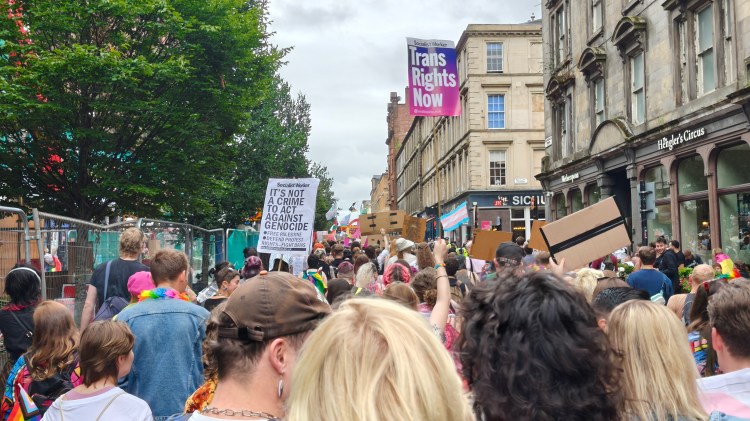
Some comments that troubled me a little more came from some of the marchers themselves. Last year there were a group of pro-Palestinian marchers who joined on the end of the Pride march. This year there was no segregation, and there were pro-Palestine banners scattered throughout the march. I kind of understand that like much of society, within the LGBTQ+ community, opinion is divided regarding the conflict in Israel and Gaza. There will be people representing all shades of views. Personally, I feel the blurring of the two issues is damaging, and that Pride should remain true to its origins: celebrating its origins and diversity whilst giving people a chance to express who they are, as well as protesting the perceived egregious loss of rights in the popular mind, and fighting to recover lost ground. We have not got to the point where we can relax about gay rights, particularly as we see our authorities equivocate and row back on their promises.
There ought to be a separate march for Palestine for those who are engaged in the issue providing the issues are clear. However, I’m sure there was an element of “you can’t touch us” from them because the combined march was so long – perhaps 1½-2 miles, and police were stretched thin along the entire route. Whether the pro-Palestine marchers were given permission, or just turned up in large numbers, I don’t know. Several times the chant went up “From the river to the sea, Palestine will be free”. It’s a divisive chant because some will be saying that it is a call for the establishment of a single, secular, and democratic state in the territory between the Jordan River and the Mediterranean Sea, where all inhabitants, including Jews, would have equal rights. Whilst that is laudable and something I would support, the reality is very different, in that both people’s distrust and hate each other and there is no chance of a stable, single state, happening anytime soon. Another more likely interpretation in my mind (given the passion), is that it is a call for the destruction of the State of Israel and, in some cases, as an antisemitic incitement to violence against Jews, though I hope I’m wrong. This interpretation is fuelled by the use of this slogan by militant groups such as Hamas, which has explicitly called for the elimination of Israel. The ambiguity of the phrase allows for these starkly different and often mutually exclusive interpretations to coexist.
If you are campaigning for setting up of a state of Palestine and the expulsion of the Jews (ethnic cleansing by forced removal or murder) from Israel, your position is morally no better than that of Israel right now, and their recent atrocities. I normally try and avoid getting too political, but there is deep hypocrisy on both sides. As a person born in the late fifties, I have lived through most of the wars that modern Israel has been involved with and have grown up cautiously supporting Israel because of the shocking treatment they have received throughout the last couple of centuries. They were the victims of pogroms in the Russian empire in the 1880’s through to the Russian revolution, Poland, Ukraine, Romania, Germany, Austria, Hungary, and some Baltic states. A pogrom is a violent riot aimed at the massacre or persecution of an ethnic or religious group, particularly Jews. The last one was at the end of the Second World War.
To that you must add in the Holocaust with up to eight million being killed in concentration camps. In an attempt to atone for that, countries like Great Britain (and others) agreed the Jews should have their own homeland. The creation of the State of Israel was “poorly managed,” and Britain must take the lion’s share of the blame. Without going through history, I am deeply saddened and critical that a people that have suffered so egregiously, can forget their own extraordinarily deep experiences, and conduct their own “program of elimination” against the Palestinians.
I am deeply critical of Israel, but Hamas are no better. The current crisis started with the attack of 7th October 2023 where 1200 people were killed and 251 taken hostage of whom 74 later died in captivity, but 20 are still believed to be alive. Sexual violence is believed to be commonplace with the women and girls. The original attack was a war-crime, and the treatment of the hostages is an ongoing war-crime. Jeremy Bowen published this helpful overview report an hour ago, as I write this.
However Israel’s response has been totally out of proportion to the initial attack, and itself seems to be a war-crime.
Commentators are recognising that Palestinians are being forced into the already crowded south, with the hope that they decide to leave and make a new life in Egypt, Jordan, Libya or some other friendly country. It is clear that none of the countries want any additional refugees, so they’ll be stuck in the open-air “prison” described by Israel as a “humanitarian city” called Rafah. In the last few months, we have seen Israel using food as a weapon, providing only four sites where it can be sought (where previously it was 400), and there are daily reports of soldiers opening fire on those queuing for food. The God of the Bible, the God of Israel, will be weeping at the appalling lack of respect the Israeli Government and IDF (Israel Defence Force) have for people. They seemed to justify that it is okay to kill 60 people at a wedding providing you kill a Hamas commander – the others simply don’t count. It is okay to kill dozens of people in a café because you killed a Hamas Operative. It is okay to shoot scores of people in a food queue if you see someone who looks vaguely, possibly, might be, a Hamas fighter. It is okay to leave them to starve. Today, again as I write this, Gaza’s Hamas-run health ministry said that 33 people, including 12 children, had died from malnutrition across the territory over the past 48 hours.
CNN wrote: “Defense Minister Israel Katz said last week he had told the military to advance plans for the zone, which would eventually contain the entire population of Gaza. The area would be built on the ruins of the city of Rafah in southern Gaza, and once Palestinians enter the zone, they would not be allowed to leave. Katz also vowed to implement a plan for the emigration of Palestinians from Gaza.
“It is a concentration camp. I am sorry,” [Former Israeli Prime Minister Ehud] Olmert told The Guardian newspaper on Sunday. “If they (Palestinians) will be deported into the new ‘humanitarian city’, then you can say that this is part of an ethnic cleansing.””
Whatever the Israeli government call it, it is thoroughly evil. I would find it very hard not to think of charging Benjamin Netanyahu, Israel Katz (Minister of Defense), Itamar Ben‑Gvir (Minister of National Security) and Bezalel Smotrich (Minister of Finance) with some sort of war-crimes / crimes against humanity. However, although a vast majority of Israeli voters are against the war, the opposition is splintered into many different interest groups, so it is difficult to envisage any early resolution. In the meantime, it is in the interest of Benjamin Netanyahu to keep the war running, because it keeps the courts who want to try him for corruption, away. However, I feel sure that he will end his days in some prison somewhere, or perhaps less satisfactorily, exile.
So, as I close, I enjoyed the day very much but was left uneasy about the twin issues seemingly being tied together. I hope that next time it will be a pure Pride march of celebration. This time, there, will have been Jewish LGBTQ+ participants, and I wonder how they felt and whether they will come next year. Have their traumas been added to? I hope that next time they will be able to celebrate their diversity, without looking over their shoulders.
But on Saturday, as I made my way home, I ducked out of the rain, and after being on my feet for over 6 hours, enjoyed a burger and a couple of beers! I hope that’s allowed!
Afterthought:
Last time I mentioned the brilliant new LGBTQ+ Podcast that started a couple of months ago called: This Was Always Me. If you haven’t listened to it, try it out. It continues to be superb.
 Changing Minds