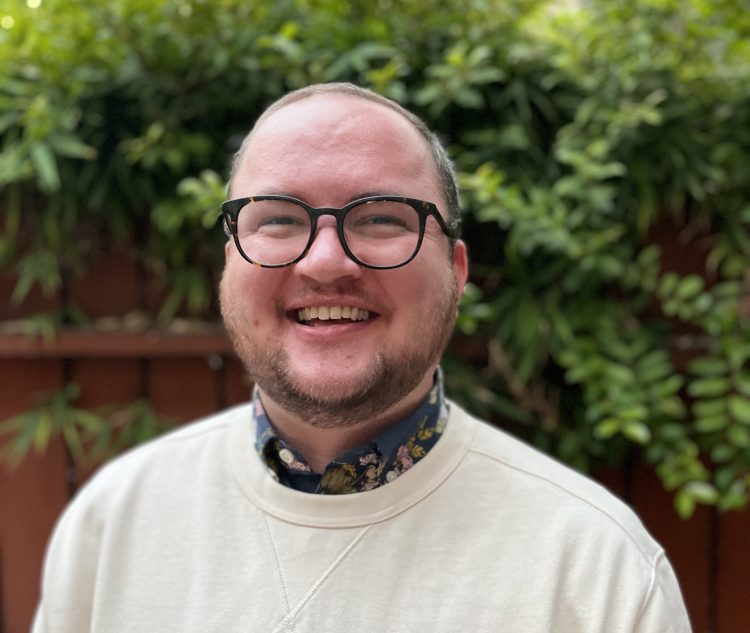
Since I started this in 2021, I have asked a few people to tell me their stories. You can find previous stories on the Blog Log page. This month I have asked Rev Greyson Kentopp to tell me about himself. I first met Greyson earlier this year when he was holidaying in the UK from the US. I quickly recognised he had a story to tell. On the 21st September 2025 he was ordained at the First Congregational Church of LA. I have not Anglicised any of the words or spellings – it is as Greyson tells it.
Before he tells us his story I must make a general comment. Usually, all the Bible links I give are directed to the BibleGateway web site which has been a wonderful resource. However, recently BibleGateway has withdrawn access to users in the UK and Europe, giving no clear reason, but assume it must be somehow related to GDPR – but I’m guessing. They also say that they are “working on a new solution”, implying it is temporary. It better be, because from my own experience, Bible Gateway is the go-to Bible tool for pretty much every Christian I know, so they will be losing market share. The impact for me is that for the time being, I will direct Bible references in blogs to BibleStudyTools.com. I can’t change all the links in all my previous blogs, so if you use a VPN, select a server based in the US or Canada, and you should be fine if you want to open those links to verses on the Bible Gateway site.
That’s enough admin, this is Greyson’s story:
I prayed to God to be a boy before I knew the term “transgender.”
Before I knew that it was possible to medically transition, before I’d met anyone who had, before I’d seen any transgender person on TV, I would thread my little hands together and pray that when I wake up for my elementary school classes the next day, God will have made me a boy. Then I’d drift asleep, dreaming of a detailed future. I knew what my haircut would be, what men’s clothes I’d buy first (a black button up, don’t ask me why), how I’d redo my room with blue paint and bedsheets. When I thought long-term, the details got less specific, but I could still see a loving home with a wife. My imagination would run wild with colors, sounds, light, and warmth. I did not know how this future would come to be, but that did not stop my dreaming.
By the time I reached middle school, I started paying a little more attention at church services. My family attended a conservative evangelical megachurch, and I began to internalize the sermons about how LGBTQ+ people were lost in sin and would not be permitted into heaven. My relationship to God became one of fear and shame. At night, I’d clasp my growing hands together and began a new prayer, that God would change me to be the Good Christian Woman I was expected to be. It would certainly take a God-level miracle for me to even perform this role, much less alter my heart to embody it without issue. I tried my best to envision what being a Christian wife and mother would look like for me, but it filled me with overwhelming dread. The dreaming of my future that was once so full of color and sound, light and warmth, was replaced by a dark void. I tried my best to conform, thinking if I moved through the motions, my heart would catch up. It never did.
I started to come out as gay to my family, using the only language I had at the time to speak to my experience. They promptly took me to a Christian counselor to sort out the “root” of my sin and left pamphlets for Exodus International, a conversion therapy organization, on my bedside. They worried about the devil’s hold on me and attributed my sin to a lack of spiritual life. How could I convince them of how much I prayed over this? Despite my prayers, God felt silent, distant. I began to believe God had given up on me. I couldn’t bear the thought and tried my hardest to become an angry atheist, but try as I might, God was as real to me as anyone I could see in the flesh.
The knowledge that I am a man only grew louder as I got older. In high school, I was introduced through a mutual friend to a transgender student at our school. He was a few years older than me and had already transitioned to a masculine name, masculine pronouns, and masculine presentation. He told me what it meant to be transgender, and suddenly I had the language I had searched for all throughout my childhood to describe my experience. The door to that bright and full future I had once envisioned for myself broke wide open again. As I began to socially transition, cutting my hair and wearing those men’s clothes I’d dreamt about, my family was ousted from our megachurch. After a little break from church life, we found the United Church of Christ, a progressive Christian denomination predominately in the US.
Our first visit to a United Church of Christ church was with a congregation that met in a business building yet somehow was able to transform those linoleum floors and sterile lights into a place that radiated warmth and welcome. It was a much smaller congregation than we were used to, but that meant people actually knew one another and engaged in lively conversation in the hallways before the service began, catching up on life events and family wellbeing. I would come to discover that smaller UCC churches sometimes have a “Joys and Concerns” portion of the worship service, where congregants can pass around a microphone and ask for prayers or share news with the congregation. I was already struck by the moving nature of this practice, but then two women stood up, arm in arm, and announced that they were pregnant with their first child. The whole congregation erupted in celebration, and I felt the room awash with divine presence. This God, whom I had felt so distant during my prayers to change, was here now, palpably, tangibly. Oh, that day I fell in love. I saw what church could be, and I had the first taste of the irresistible tug towards church that would come to define my life ever after.
I would come to be a nuisance to the associate minister of that church, who took me under her wing as I went through my deconstruction and reconstruction*. I was alight with desire for God, a breaking open that was able to happen because I found a church that not only accepted but affirmed and celebrated me as created in God’s image as a transgender person. I became obsessed with scripture and theology and volunteered to be a reader for worship services as often as I could. One day, the associate minister took me to coffee and asked me if I’d ever considered ministry as a vocation. I immediately said no, absolutely not, surely that’s not my path. We left that conversation and about a week later I asked the minister to coffee again. The thought had not been able to leave my mind. I felt God reaching for me, and I felt overwhelmed with what grace that was. With great joy and gratitude, I have taken God’s beckoning hand to follow God’s call into ministry. I journeyed into divinity school, where I would meet the incredible woman who would become my beautiful wife. My childhood dreams of a future full of vibrant life and fierce love has become my reality, and in that reality I now see differently. All those nights I spent fervently praying for God to change me, God did not respond – not because God had given up on me – but because God loves me and desires communion with me, just as God created me to be.
Being transgender has expanded my life in beautiful ways. It has offered me a sacred experience of the divine that I would not have if I were not transgender. Many people expect the God who separated night from day, who works within the boundaries of clearly defined lines, but I know a God of twilight and dawn, the unique spaces where two supposedly separate things meet, dance, blur together. I resonate with the idea of a Trinitarian God, a topic often left to its mysteries, because I know what it feels like to hold a diversity of experiences within the unity of my own body and self. Maybe this is how transgender people embody the image of God in our own way, by honoring the diversity in God’s own being and within God’s creative acts. We are evidence that God’s creativity and love extend beyond the lines humans draw in the sand.
Scripture gives us examples of times when gender expansive people are enfolded into the divine life moving in our world. Isaiah 56: 3-5 shares that eunuchs (defined broadly as people who did not fit neatly into the gender binary at that time) who follow God will receive a monument and an everlasting name. Acts 8: 26-40 shares a story of Philip being directed by the Spirit to chase after the Ethiopian eunuch. Philip discusses scripture with the eunuch before baptizing them, allowing the narratives of the eunuch’s life to be transformed. Their old understandings of who they are and what they have to offer the world have died, and out of that baptismal water, they rise claimed by God and proclaiming God. Here we see that God not only loves gender expansive people and honors us just as we are, but God actively seeks after us, inviting us into covenantal relationship with the divine and into community with others.
Now, if only the world could believe this too. While I usually like to focus on trans joy and sacredness, I have to admit that it is a scary time to be transgender. We are at an urgent crisis point as transphobia runs rampant and is only getting stronger in places like the US and the UK. Transgender people watch with horror as everyday a different right is stripped away or a new dehumanizing narrative is spun or another beloved member of our community falls victim to a hate crime. I am daily gripped by the terror of where this level of transphobia leads if it is not stopped and do my best to find pieces of hope and solace even here, even now.
Recently, I was reading the Gospel of John and found resonance in 15:18-20, “If the world hates you, be aware that it hated me before it hated you. If you belonged to the world, the world would love you as its own. Because you do not belong to the world, but I have chosen you out of the world, therefore the world hates you.” This passage describes (not prescribes) what happens when following God over the rules of the world comes into conflict. I take a strange comfort in Jesus’ words describing the hatred of the world towards those who do not fit into prescribed rules of being and acting within our societies. Trans people don’t play by the worldly rules people have arbitrarily drawn around so-called “immutable” gender. We listen to that internal voice, that sacred voice, that puts us at odds with this world but opens up a doorway of an expanded life, a deepened life, lived in the pursuit of authenticity, self-love, and creativity. Jesus knows what it is to be hated, what it is to experience violence and an undignified death, just as our trans communities know all too well. Because Jesus knows this hatred, we know that God is with us in our own experience of being hated. God has walked this walk in the incarnation. We then can know that every aspect of our experience as transgender people – the joys and pains, the grief and wonders, the terror and peace – are held firmly and tenderly in God’s care. There is no part of our lives that is outside of God’s embrace. Our lives, our bodies, and our worth are defined instead by the God who called us into being with love and intention, the God who declares “I will place them in the safety for which they long” (Psalm 12:5), the God who accompanies us through the darkest valleys and leads us beside still waters and green pastures (Psalm 23). We are beloved children of God. That is our story, inherent to our very beings. No amount of hatred on this Earth could ever change that.
God does not desire this hatred for us. God has infused our lives as transgender people and has intertwined God’s own story with ours. The beauty of this is that God’s story never ends with the hatred and violence that led to Good Friday but instead begins anew with the breaking dawn of a resurrection of spirit and life on Easter Sunday. God has lovingly and intentionally called us into being through expansive, creative acts and walks with us towards futures of vibrant life and fierce loves. Transgender people offer so much beauty to this world and such rich perspectives of the divine. We are sacred beings and deserve a life where we can thrive to the fullest, just as much as anyone else. When the voices of hatred get too loud, Jesus leads us onward, whispering incessantly in our ears, “You are beloved. You are beloved. You are beloved.”
May the God whose creative acts defy our definitions bless those who transcend binaries and bless our work to protect those lives, so that all may flourish in love and community.
Rev. Greyson Kentopp
*Deconstruction and reconstruction: for those unfamiliar with the idea, this is the process of questioning, dismantling, and then rebuilding one’s beliefs, often leading to a more personal, refined faith. Many of us have gone through the process when our experiences painfully jar with what we mistakenly think the Bible is saying.
I am deeply grateful to Greyson for willing to be so vulnerable in writing this piece. Those final paragraphs reminded me of a Twitter exchange early in 2018, where Vicky Beeching* (Christian broadcaster, singer/song writer, author, theologian) was being vindictively attacked (purportedly and sadly, by other Christians) for her Christian witness after coming out as lesbian, and a gracious response was posted from @Bethany26, saying: “Don’t listen to the loud voices of the haters. Listen instead to the whispers of the queer Christians sitting in the back of the church wondering if they’re going to be ok.” And, as Greyson says, Jesus whispers back, “You are beloved” as he takes them into his arms and clasps them close.
I don’t want to say more, because Greyson finished so beautifully.
[*If you haven’t already, please read Vicky Beeching’s book “Undivided: Coming Out, Becoming Whole, and Living Free From Shame”]
 Changing Minds