At present, I’m working my way through my original essay that I began writing around 10 years ago. It forms the basis of my current thinking, and now I’m exploring the significant issues I tackled, in an attempt to bring it up to date.
In my previous blog, I considered the perceived tensions between the Bible and science and concluded that neither was a threat to the other. Many of today’s churches seem to worry about science, especially in areas like Creation and evolution, but there is really nothing to fear. Science and Scripture are asking different kinds of questions and describing reality from different perspectives. Science is concerned with observation, experimentation, and explanation; the Bible is concerned with meaning, relationship, morality, and humanity’s encounter with God. Better science refines scientific understanding, but it does not challenge Scripture, and sometimes even informs what we read.
The next area from the essay that I wanted to look at was to look at the different forms of relationship and marriage described in the Bible, and ponder whether it should inform our thinking about marriage between people of the same sex. By “marriage,” I mean what society generally understands as a formally recognised and enduring union between people.
One man and one woman?
Most Christian denominations, still maintain that “marriage” can only exist between one man and one woman. Yet, possibly perversely, churches generally recognise marriages performed outside a Christian ethos — those of other faiths or no faith at all — provided they are entered into freely, legally, and intentionally. I find that contrast interesting. There are many religions that have a pantheon of god’s, and you’ll find all sorts of representations in temples across the world. The Bible speaks strongly against idolatry and unbelief, yet the Church has historically had little difficulty recognising such marriages as valid, while many faithful gay Christians remain unable to marry within the Church they are committed to. I suspect much of this is due to a failure to properly understand what it is like to be gay or lesbian.
At the same time, some churches have begun to move cautiously in a different direction. In recent years, parts of the Anglican Communion have authorised prayers of blessing for same-sex couples following a civil marriage ceremony. In these situations, the legal marriage itself is recognised as a valid binding union by the church, while it simply offers prayers for God’s blessing upon the couple and their shared life together. But the church won’t conduct the actual ceremonial union itself.
Generally, such blessings ask God to:
• strengthen the couple’s union,
• sanctify their common life,
• deepen fidelity and mutual love,
• make the marriage a sign of divine grace.
The oddness of the situation is exacerbated by the different types of Marriage that you find described in the Bible, none of which any of the Bible writers seem to quibble with. One might expect that when either God, or Jesus, is brought into the narrative, it would be made clear they would raise an eyebrow and make a clear pronouncement of what is considered a valid form of marriage. Instead, there is silence, and they simply address other pressing issues.
What makes the discussion more complex is that the Bible itself presents a surprisingly wide range of marital arrangements. My argument is not that every biblical model should be copied today, nor that every relationship described in Scripture is automatically endorsed by God. Rather, I believe the Bible presents a much broader and more complicated picture of marriage than many modern Christians acknowledge. For those taking the Bible literally, this must present a huge obstacle.
Scripture appears far more concerned with:
• faithfulness,
• integrity,
• covenantal commitment,
• honesty,
• and the loving treatment of others
than with the exact structure or number of partners in a relationship.
We tend to think that the Bible only advocates one type of marriage, that of one man and one woman. In fact, that owes much more to culture and practicality, than scriptural command.
In the beginning…
Of course, the glorious idyl of Adam and Eve in the garden is the go-to example of most church leaders, because it is the very first people and was comprised of one male and one female. To be fair there were no other options, and if God in the story had made two males, or two females, the experiment would have been short-lived, and you wouldn’t be around to read this! However, scandal alert: they never got married in the way we recognise—no formal exchange of vows. They didn’t promise: “for richer, for poorer, in sickness and in heath…” They just got on with it and consummated their relationship by making love, and in God’s sight, that was their marriage!
That’s a little awkward for many Christians today, if that’s the prototype example. It comes of taking the story literally and following it to its logical conclusion. Over the following years it all became far more complicated, because what we now call polygamy, became the norm. In my original essay I addressed polygamy, but to shorten it, as human societies developed, marital arrangements became far more varied and complex. In fact, what we now call polygamy appears throughout the Old Testament and is often treated matter-of-factly within the narrative.
For clarity, several terms are worth defining:
• Polygyny — one man with multiple wives,
• Polyandry — one woman with multiple husbands,
• Group marriage — multiple husbands and wives,
• Sororate marriage — one man marrying sisters, (Jacob – Genesis 29: 16 – 30: 10)
• Fraternal polyandry — one woman married to brothers.
Most biblical examples are forms of polygyny.
The example of the Patriarchs and kings
The earliest example appears in Genesis 4, where Lamech is described as having two wives, Adah and Zillah. Abraham (see Genesis 16: 1-4; 25: 1-2), Jacob (Genesis 29: 16 – 30: 10), Esau (Genesis 28: 8‑9), and many others are also described as having multiple wives or concubines.
I must specifically mention David and Solomon because of their importance in Scripture. From here onwards, sentences in blue are quotes from that earlier essay, and square brackets are where I have edited that text:
David (2 Samuel 5: 13; 1 Chronicles 3: 1-4; and there were other passages because Bathsheba’s son Solomon isn’t mentioned in either passage). We will mention Solomon in a moment, but sticking with David, we ought to mention 2 Samuel 12: 8 where Nathan convicts David of his sin with Bathsheba, and quotes God saying:
“8 I gave your master’s house to you, and your master’s wives into your arms. I gave you all Israel and Judah. And if all this had been too little, I would have given you even more”.
The implication is that not just land and treasures, but further wives would have been given, if David had asked – since taking another man’s wife was the charge being levelled against David. I Chronicles 3 indicates David had children from a minimum of seven wives excluding those from all his concubines. If you look at 2 Samuel 3 (a companion passage to the above, where the names more or less agree, between the two passages), we are given the names of six children, each to a different mother, then in 2 Samuel 5: 13, we are told that: “13 After he left Hebron, David took more concubines and wives in Jerusalem, and more sons and daughters were born to him.” So, he probably had far more than seven wives, excluding concubines!
Solomon (1 Kings 11: 3 – 700 wives and 300 concubines, and God is silent about polygamy! [Well, that verse says his wives led him astray, but that is a reference to idol worship, not that polygamy itself is wrong in principle.] In fact, God blesses Solomon, and his sexual relationships seem irrelevant) – in fact, most of the kings had multiple wives. I need to be fair: God DID say something about multiple wives, but only much earlier, at the end of Moses life while making his farewell speech in Deuteronomy, where we read in chapter 17:
14 When you enter the land the Lord your God is giving you and have taken possession of it and settled in it, and you say, “Let us set a king over us like all the nations around us,” 15 be sure to appoint over you a king the Lord your God chooses. He must be from among your fellow Israelites. …
17 He must not take many wives, or his heart will be led astray. He must not accumulate large amounts of silver and gold.
To clarify that, God doesn’t address polygamy as such, because He didn’t say you can’t have more than one wife, but that you shouldn’t have “many” wives. …
… So, if God says nothing, and the nation views it as a blessing from God, how can multiple wives (2, 3, … 700) be a problem? It seems to be a lifestyle choice based on economics and politics in Solomon’s instance, but also of social protection of the vulnerable as in Levirate marriage. We can’t make the argument that after Jesus, polygamy is a sin but beforehand it wasn’t.
Is polygamy a sin in the Bible?
Significantly, while Scripture often records the problems and tensions arising from these relationships, it doesn’t condemn polygamy itself outright.
This does not necessarily mean the Bible endorses polygamy as an ideal. However, it does demonstrate that Scripture does not consistently define marriage exclusively as lifelong monogamy in the way many modern Christians assume.
Don’t forget that instance in Matthew 22:23-32, when the Sadducees came to Jesus with the theoretical story of a widow who married seven brothers, one after another as they kept dying off without fathering a child. The story was an example of Levirate marriage, which was where the widow would be given in marriage to the next of kin brother, if no children had previously been born to carry on the family name. It also protected the widow from destitution. Jesus makes no comment about what he thought of Levirate marriage. If he wanted to make a point that one-man and one-woman was the way to go, Jesus or Matthew could have added a comment. However, the main thrust of the story isn’t about marriage but about heaven.
So, either the principle of:
polygamy is a sin or it isn’t, and the Bible presents no compelling evidence that it regards it as a sin. The Bible does give basic principles that it considers important in marriage but doesn’t legislate the form it should take. We can happily say that we culturally disapprove of polygamous marriage, and attest that it is difficult to have a covenantal relationship with two or more spouses, so polygamy may not be a good model. But we can’t make a strong argument that the Bible thinks it is wrong/sinful. However, we can infer that God requires that each wife must be truly loved and honoured. [Genesis 29: 31; Deuteronomy 21:15-17; Colossians 3:19; 1 Timothy 3:2, etc. Don’t forget the context of the time that wives had no more value than any other possession, so this was a real change of cultural thinking.]
Let’s move it on a bit because there is a helpful infographic I came across many years ago, and even at the time I couldn’t track down the source to quote it. I’ve tried again more recently but can only find out that it seems to have been common in debates about same-sex marriage around 2012–2015. I can’t remember where I first saw it, but the earliest I can find in a dated blog, is on the Canyonwalker Connections website from June 2015. I heartily commend the website, and Kathy Baldock has lots of resources that support the LGBTQ+ community, and I have links to several of her books and videos on my Resources page.
There are two new books written by Kathy that I must mention, and both are due out on Kindle on June 1st. These are:
- “Forging a Sacred Weapon: The 1946 Bible Mistranslation Behind Anti-Gay Theology”. “In 1946, a single English word appeared in the Bible for the first time. That word was homosexuals. At the heart of the story: David, a young seminarian who discovered the error and wrote directly to the Revised Standard Version translation committee in 1959 to correct it. His concern was taken seriously—but the publisher’s policy prohibited changes to the translation for ten years. The word stayed. And its consequences spread.”
- “I Wish to Express: The Story He Never Got to Tell: David Fearon and the 1946 Bible Mistranslation.” This is the story of David Fearon, that young, closeted seminary student, studying at McGill University.
Other strange forms of “acceptable” marriage
That infographic I referred to is this:
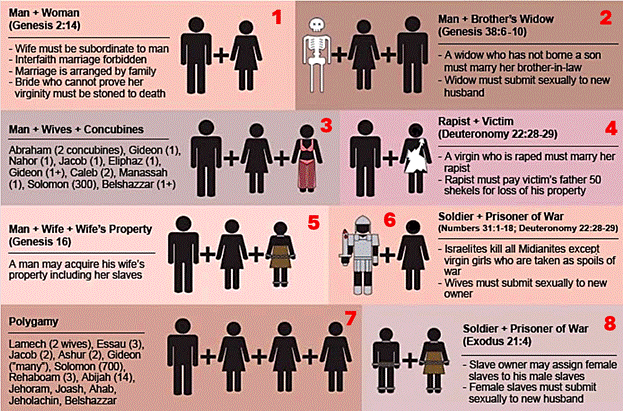
This shows all the different types of marriage recorded in the Bible, some recorded matter-of-factly (1,3 and 7), and others by way of command (2, 4, 5, 6 and 8). Please take a few moments and read through the Bible references quoted, as I don’t want to do an in-depth analysis of each!
What about the New Testament?
As I said before, at no time does any Biblical writer, either themselves, or by putting words in God’s mouth, say that any of these forms of marriage was wrong. All of those were Old Testament passages, but what about the New Testament? The default passage that many Christians quote, where Jesus addresses marriage, is in Matthew 19: 3-8 and the text reads: –
3 Some Pharisees came to him to test him. They asked, “Is it lawful for a man to divorce his wife for any and every reason?” 4 “Haven’t you read,” he replied, “that at the beginning the Creator ‘made them male and female,’ 5 and said, ‘For this reason a man will leave his father and mother and be united to his wife, and the two will become one flesh’? 6 So they are no longer two, but one. Therefore what God has joined together, let no one separate.” 7 “Why then,” they asked, “did Moses command that a man give his wife a certificate of divorce and send her away?” 8 Jesus replied, “Moses permitted you to divorce your wives because your hearts were hard. But it was not this way from the beginning.”
The difficulty in making this anti-homosexual is that Jesus is answering a question about the rightness of divorce, so is addressing the parties to the marriage and telling them they should not separate. He makes an observation or recognition about how things generally were [at the time] but then makes a command [not to divorce]. This is not a treatise by Jesus on sexuality, but on divorce – which severed what God has brought together.
The observation or recognition is reflecting what was going on in society around him, and the command is: don’t divorce – God doesn’t like it outside of a last resort. Note that the command isn’t that marriage can only be between a man and a woman, but that people shouldn’t divorce. People focus on the phrase “a man will leave his father and mother and be united to his wife” assuming this is a proof text to show Jesus was talking about God’s sole model for marriage, but do we really want to emulate marriage as it was when Jesus walked this Earth? Returning to my earlier writings:
There is a lot about marriage in Jesus’ day that we would object to:
• the arrangement of the marriage when the children were [very] young [sometimes pre-school age];
• the marriage, when they were barely teenage;
• the likelihood that the husband [might on occasions] be much older than the bride (10/15+years older). (cf. Mary and Joseph)
• the treatment of the bride as property.
“Jesus does not comment on the highly non-romantic ways in which marriages were contracted in his time, nor on the relational quality of the resultant bonds”.* Jesus could have spoken on all sorts of issues surrounding marriage, who it could be with, how it could be contracted, at what age, but he doesn’t. His teaching was purely against divorce.
* p274, Kingdom Ethics – Following Jesus in Contemporary Context (Second Edition) by David P Gushee & Glen Stassen. Wm B Eerdmans Publishing Co.
Although Jesus says nothing about what makes a marriage and is not critical of arranged marriage, or getting married too young, or age differences, the one thing he does pick up on which still applies, although not marriage specific, is in John 13: 34, which says: 34 ‘A new command I give you: love one another. As I have loved you, so you must love one another. This establishes self-giving love as the defining mark of his followers, which is also clearly applicable to both spouses, and therefore provides a clear teaching against viewing people as property.
Conclusions
I think the main conclusion we can make is therefore that marriage is a social and human construct. When missionaries first travelled to Asia, Australia and the Americas, they found that indigenous societies typically had socially recognized marital or marriage‑like institutions— they had rules governing long‑term partnerships, sexual access, childrearing, and inheritance. However, the forms and meanings varied widely from European marriage. These people didn’t know God but had recognised that there needed to be rules around publicly confirming sexual relationships and it is convenient to define these as marriage in some form. So, I don’t believe God is phased about what form of marriage has been entered, simply that the people involved loved, respected and honoured their partner(s) in a self-giving fashion.
So, from that perspective I have real difficulty turning to someone who is part of the LGBTQ+ community and telling them that, they can’t “marry” and can’t give and receive (share) love with a partner. This destroys any hope and longing that person might have, which is antithetical, of any teaching from the Bible. Even Paul recognised the danger, because he wrote to the Corinthians, saying:
8 Now to the unmarried and the widows I say: it is good for them to stay unmarried, as I do. 9 But if they cannot control themselves, they should marry, for it is better to marry than to burn with passion.
1 Corinthians 7:8-9
How many supposedly strong Christian leaders have been found out as having had extra-marital affairs? There have been so many. They have destroyed their ministries, so how in God’s name do you expect people who have been bullied and damaged throughout their adult life, to be strong and remain celibate, when so many strong characters have hypercritically, utterly failed. Earlier I quoted from Matthew 19. Later in that chapter Jesus talked about celibacy being a calling, not a command:
10 The disciples said to him, ‘If this is the situation between a husband and wife, it is better not to marry.’
11 Jesus replied, ‘Not everyone can accept this word, but only those to whom it has been given. … 12 … The one who can accept this should accept it.’
Extract from Matthew 19: 1-12.
Clearly Jesus didn’t expect everyone to be able to adhere to the idea of celibacy, so it is obviously NOT a command. We will probably come back to the celibacy theme in months to come, since so many churches expect gay people to be celibate unless they are in a traditional male-female marriage.
In conclusion, whilst we might expect traditional marriage relationships to demonstrate a covenantal love and sacrifice, we should also see faithfulness, permanence, integrity, mutual respect, along with a care and compassion for the vulnerable. I’ve seen this in relationships within the LGBTQ+ community too, but it could be made so much easier if the whole church got behind the community and provided love support and encouragement instead of criticism, distrust and suspicion.
Do you agree? Where do we differ? Let me know via the “Contact” page.

