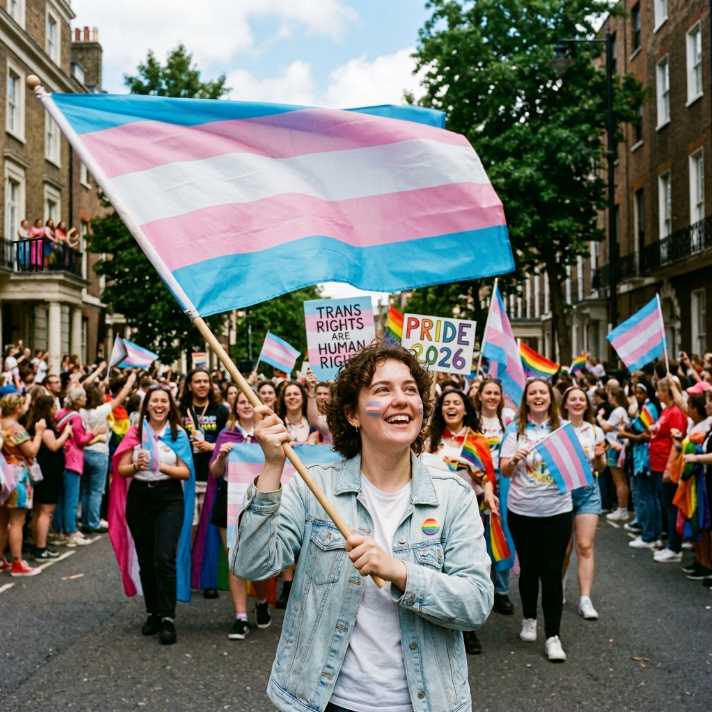
For any new readers this current series of blogs is intended to look back at the themes I covered in an essay I wrote between 2015 and ~2020, and which proved foundational to my own understanding of God’s love for the LGBTQ+ community. The essay is too long but was only initially intended for my own reference, until others insisted I make it available for anyone to read. It was long because I wanted to make sure I hadn’t missed anything obvious, and had addressed every argument a person might raise. These blogs are therefore aimed at bringing it up to date, but in a hopefully shorter, and certainly different, form.
I gave myself a month off in July because I was heavily involved as a volunteer at the Glasgow Commonwealth Games and didn’t have the time to get a blog written, so this month I need to pick up from where I left off in June. I have a certain amount of trepidation because the issue of Transgenderism is one that has been very divisive within society in the last few years. Indeed, it is even divisive within the LGBTQ+ community itself, which I find troubling.
Definitions
However, I would like to broaden it a little so that we look at both transgender and intersex issues. As I write, I am aware that I am walking through a minefield, and each reader will have placed their mines in places that are specific to them, and any warning flags, will only be visible to them, so please forgive me if I seem to be a bit clumsy! I’ll try hard not to offend, but I am still learning.
So, let’s define our terms: Someone who is transgender is a person whose gender identity differs from the sex they were assigned at birth.
To understand this concept better, it helps to look at some key terms:
- Gender Identity: A person’s deeply felt, internal sense of who they are, whether that is male, female, or some another gender (such as non-binary).
- Assigned Sex at Birth: The sex (male or female) that a doctor or midwife declares a baby to be at birth, usually purely based on external anatomy/appearance.
- Someone whose gender identity is non-binary may also describe themselves as transgender, but only if they identify with that term.
To try and explain that phrase, “deeply felt, internal sense of who they are” I came across a couple of helpful metaphors:
- Firstly, being trans is like having clothing that never quite fit: Realizing the outfit you were handed at birth isn’t your size or style. You’ll probably have all looked at a tee-shirt turned it around so it’s the right way to wear it, only to realise you’re wearing it back to front, and it feels really strange – but if you’re trans you don’t get the option to change it. Accepting you are trans is like finally putting on clothes that fit perfectly, as well as feeling comfortable and authentic to you.
- Secondly, it is like tuning a radio – moving the dial from a station with a lot of static and noise to one that comes in clear and sounds like you.
When a person’s internal gender identity matches the sex they were assigned at birth, they are referred to as cisgender. When it does not match, they may identify as transgender. It doesn’t by itself say anything about whether they’ve medically transitioned, changed their appearance, or undergone surgery, it is purely their identity.
Transgender people may take steps to align their outward appearance and social role with their gender identity. These steps can include social transitions (such as changing names, pronouns, or clothing), legal transitions (updating identification documents), or medical transitions (such as hormone therapy or surgeries). However, not all transgender people choose, or have access to, all these options, and being transgender is primarily about a person’s internal identity. Many have no choice but to live in social awkwardness and often, fear of hostility.
Just to explore the prefix word “trans” for a minute. From its Latin derivation, it can mean “across,” “beyond,” or “on the other side of,” in the sense of trans-Atlantic or trans-continental, which pictures a position on the opposite side to the starting point. Exploring the concepts a bit further, historically, the word trans– was used in contrast to cis-, where cis- means “on this side” and trans- means “on the other side.” Many people outside of the community had not really been aware of the word “cis-” until perhaps the last 10-15 years. The prefix words “cis- and trans-” have their roots in the Latin spatial distinction “this side / the other side.” So, in the context of gender, trans can convey the idea of being on the other side of the gender category associated with one’s sex assigned at birth. The word “cis-“, is not a new word, but is very old (I mentioned its Latin roots) and its use has largely remained confined, until recently, to the mathematical, scientific and geographic terminology.
Moving back to the human experience there are some who continue to use the word transexual, so I am using the word “trans” throughout the piece to avoid unnecessary unease. By way of background, I understand that the word “transsexual” is older and is often considered more medicalized (it comes from earlier clinical language), so it gets used far less frequently today.
Intersex
At the beginning I also referred to “intersex”. This is a broad term for people born with sex characteristics that don’t fit typical definitions of male or female. Those characteristics can involve chromosomes, reproductive organs, hormones, or genital anatomy. An intersex variation may be apparent at birth, or become noticeable during puberty, or only be discovered later through medical testing. Sometimes it may not even be revealed until post-mortem. In this context, there are huge numbers of different intersex variations.
Let’s be clear and make some distinctions, which echo some of what we have said:
- Intersex describes biological sex characteristics (the actual physical structure of a person’s body).
- Transgender describes gender identity.
- An intersex person can be a man, a woman, non-binary, or another gender identity—being intersex does not determine someone’s gender. The prefix “inter” should be a clue!
One subtle point: intersex isn’t simply a “third sex.” It’s an umbrella term covering a whole range of naturally occurring variations in human sex development. If you count individual genetic, chromosomal, hormonal, and anatomical conditions separately, there are hundreds of intersex variations, and fortunately, they are rare, but occur regularly. Because of this, life is extremely hard for this group of people, since how can others truly know what they experience and feel, and the isolation. Consider the fear of others finding out, the feeling of embarrassment or shame, the secrecy, the difficulty of finding a partner — someone with whom they can exchange love?
By looking at intersex conditions, gender dysphoria, and transgender experiences, I want to argue against the traditional Christian view that human identity is strictly divided into two binary categories. Rather than treating transgender identity as rebellion, sin, choice or defect, Christians should regard trans people as people made in God’s image. They should listen to their experiences, and respond with love, dignity and inclusion. This is true too of our intersex siblings, where Christians theoretically are more sympathetic, because they recognise they had no choice over their identity, but the language that churches use, is usually binary and exclusionary, and churches may not even be aware they have someone identifying as intersex, worshipping among them. This person may be incredibly hurt by the careless and insensitive language people use – and I need to be careful too.
Where is my nearest doppelganger or am I unique?
As I inferred just now, many people, and not just Christians, see sex and gender as binary. This is a provably flawed and illogical assumption, as I have just shown. But for any new readers I need to make the point again: there other issues to consider. Outside of being a twin, how many people in my church, my club, my city, are identical in every way to me? Have you ever met your doppelganger / someone identical to you. I have many times sat in a church and the preacher has spoken of our/my uniqueness before God. That is one clue. There is a certain irony that evangelicalism (and by way of credentials, I spent close to sixty years in various Baptist churches) proclaims our uniqueness on the one hand, but then says we all fall into only one of two groups: male or female, and that we are the therefore the same as around 50% of the people living around us. Uniqueness? Go figure!
Next, let’s look at Evangelicalism’s concept of the Fall, where sin entered the world and fundamentally altered everything. This argument treats Adam and Eve as the original blueprint for humanity, insisting that God created one man and one woman, and that anything outside of this binary is outside of His plan. (This raises the painful question: how does that leave intersex individuals feeling?) The ultimate inference is that anything deviating from this original design is the result of sin. The line of thinking is that the “fall” affects everything that makes us human except our sex and gender, which strangely remains unaffected since creation. But that is theological nonsense! I’ve described previously how shallow that thinking is. But let me make the point again: what was the skin colour of Adam and Eve? Indeed, were they the same colour? Was Adam black and Eve white? How big were their hands; their feet; their legs; arms; musculature; their torso’s; heads? How intelligent, quick witted, passionate, creative, humorous were they? We talk about some people having an “athletic build”, so what about the rest of us? All sports people have something special about their body make-up: maybe it’s big hands and feet, and long limbs which is likely to make them great swimmers; athletes with long legs ….
Athletes train not to develop a skill they have no hope of finessing, but to sharpen, or hone one that their body proportions already give them an advantage with. If you are taller and have longer legs, your stride length will be much greater than that of a shorter person. You will never again see a diminutive 100m/200m champion. They will probably be jockeys. Likewise, you won’t see a heavily muscular 6-foot six-inch jockey! Big people can ride horses, but not race them. Good hand/eye co-ordination with good reflexes might help with games involving bat/ball/puck, etc. You can apply those principles to pretty much every sport, with the exception of fishing, I suspect! Sport is not a level playing field – and never truly has been. We are not made identical or equal – get over it!
Getting back on track (excuse the pun) the argument goes that with the “Fall” (when sin entered the world) death and disease spoiled what God had created, thus producing the circumstances for things like genetic differences to occur. I have to say I struggle to see the Adam and Eve story as anything other than a story, a picture for the people of the time to help them conceive of the concept of right and wrong and that doing right made God smile and doing wrong has bad/very bad effects – and that it didn’t take long for people to make some very bad decisions. I struggle to look at the creation story and argue that death/disease wasn’t around till Adam and Eve “sinned”. Let me explain:
The science bit!
Hominids haven’t been around very long in the scheme of things, only ~6-7 million years. The fossil record shows death and disease were present for billions of years. Digging deeper: the oldest evidence of life (stromatolite-like structures and other microbial evidence) date to ~3.5–3.8 billion years ago. They had to die to become a fossil. The oldest widely accepted animal fossils date to ~600 million years ago (the Ediacaran period), which were early multicellular animals. For soil to develop, it required the death of vegetation and organisms, so if Adam was to “till the ground” (KJV but see Gen 2:5 & 15; 3:23), death of varieties of organic life must have already occurred, to create the soil. Note that Adam was made with the potential to die – Genesis 3:22 says: “He must not be allowed to reach out his hand and take also from the tree of life and eat, and live for ever.” Notice that: “He must not be allowed to … live for ever“. God intended Adam (/Eve) to die. God created life (whether single/multi-cell, animal, vegetation etc.) knowing it would die at some point, so I would argue death existed before the “fall”.
So, to return to the discussion, to be consistent, if you differ in any way from either Adam or Eve (I used skin colour just now), given that they are the supposed prototype mould we should all conform to, logically you must be an “abomination”, to use the language of the anti-LGBTQ+ hate preacher. So, if the “original pair” were Middle Eastern dark brown or black, does that damn everyone else? As a white Brit, I’ll be in trouble! In the area of gender and sexuality you can say that typically most people are either male or female so, superficially (but keep in mind what I mentioned earlier) conform to the stereotype of Adam and Eve, but this spectacularly backfires when you look at how we all differ from them in terms of our levels of intelligence, creativity, character and all the rest. It is entirely logical to think that there are people alive today who are more intelligent than Eve and Adam, so are they an abomination, because they don’t match the original template? Are basketball players an abomination because they are likely to be so much taller than the “original pair”? I need you to follow the logic to its conclusion. What about all the other areas of difference to the “original pair”?
If you bumped into someone who DID look identical to you, what are the chances they would have the same interests, skills and IQ, read the same books, watch/play the same sport, etc. I think I have made the case, so, moving on, with the almost infinite variations that occur with people, how can anyone with any intellect seriously argue that gender and sexuality are unchanged since the “Fall” and have not been affected by the same developments and changes that have affected everything else that defines us as human?
The differences in sexuality I have mentioned are entirely natural, and to be expected from a statistical projection given the number of genes we have. Genetic aberrations occur very naturally. However, looking more widely, scientists have documented same-sex behaviours, pairings, and other diverse characteristics in well over 1,500 to 6,000 animal species across the globe, ranging from primates and marine mammals to birds, insects, and reptiles. Don’t take my word for it, do your own research! 😊
As for transgenderism, we obviously can’t easily ask a male crocodile (name your own creature!) if it identifies as female, but we see several fish-types (clownfish – think Nemo(!), wrasses, parrotfish, groupers, sea bass, and others where they can change gender over time if the colony is imbalanced. Then we have worms, slugs, snails and others who are hermaphrodites and after coupling, both can produce young. So, we can conclude that what we see experienced by our peers, reflects what we see in the natural world.
The challenge to Christians
There is also a whole raft of other situations that occur quite naturally in nature, such as intersex conditions (my friend Graeme, had an intersex chihuahua for many years.), differences of sex development (DSD), chimerism, and others. I can’t go into details of each, because they are complex and I don’t have the space (I have given some links as a starter), but if any are of interest use a search engine and look for the science-based papers to explain each in turn. All occur quite naturally, but because the noisy people have nailed down the idea that you can only be either male or female, but nothing else, these vulnerable folk have been made to feel terrible, and there’s nothing they can do about it, and the God of the Bible, if truly real, must have a message of hope for them to hold on to — just as there is for the cis-gendered. In that context, the verses that come to mind are from Isaiah 56:3-5 where they use the word “eunuchs” to talk about all those unable to have children and go on to say:
“I will give them—within the walls of my house—
a memorial and a name
far greater than sons and daughters could give.
For the name I give them is an everlasting one.
It will never disappear!”
The attitude of many people in both society and the church is that they see being trans as a choice, rather than something that is integral to that person. I have shown that this occurs in nature and so it shouldn’t be hard to accept that it occurs in people. I have to ask, why would people CHOOSE to be trans? The costs of being transgender are huge:
• possible loss of family relationships
• social rejection
• discrimination
• bullying
• medical treatment / surgery
• lifelong medication
• possible loss of fertility
• financial costs
• hostility from religious communities
• psychological distress.
So, my challenge is to ask Christians to imagine what it would be like to experience gender dysphoria. And treat it seriously. Don’t begin with: “Is this permitted in the Bible?” Instead begin with: “What is this person’s real experience, and how do I follow Jesus’ example and show that both He and I truly love them? How can I show them what the real Jesus, the Jesus of the Gospels, is like?” I suspect that Jesus would be like the father in the story of the lost (prodigal) son in the gospel of Luke. The story tells of a lost son, but it could easily have been a daughter, and Jesus’ response would have been identical:
20 So he got up and went to his father. But while he was still a long way from home his father saw him, and his heart went out to him; he ran and hugged his son and kissed him. …
22 But the father said to his slaves, ‘Hurry! Bring the best robe, and put it on him! Put a ring on his finger and sandals on his feet! 23 Bring the fattened calf and kill it! Let us eat and celebrate, 24 because this son of mine was dead, and is alive again—he was lost and is found!’ So they began to celebrate.
Look at how Jesus treated marginalised people and use that as the model. Throughout the Bible we are taught to stop looking at the rules but look at the heart of the person (see Psalm 51: 16-17; Isaiah 1:11-13, 16-17; Hosea 6:6; Micah 6:6-8; Romans 12:1 – and so many others!). Our example is to look at Jesus’ radical acceptance of people who are regarded as outsiders. Christians too easily become preoccupied with categorising people “correctly” (Are they saved? Are they behaving properly?) instead of simply loving them. Please don’t forget that just saying you love somebody is very different to the actions and attitude that show how much you truly love them.
Today, being trans, and, to a lesser degree, being part of the wider LGBTQ+ community, is being seen with growing disapproval after several years of positive progress. Back in 2019 we saw two lesbians attacked late at night on a London bus. In a BBC Horizon episode in 2017, called “Being Transgender”, it was stated that “as many as 40% of Transgender people have attempted suicide”. The community faces higher attempted suicide rates, abuse, discrimination, violence and discrimination, and the church holds the coats of those doing the abuse, if not actually cheering on from the side-lines. I find it sickening.
I haven’t drawn from any Bible texts directly related to being trans, as there aren’t any – well there is Deuteronomy 22:5 which people twist and tear out of context, but we will come back to this next time! Quick comment, if you say verse 5 applies, you must also advocate for the verses later in that chapter – and just to demonstrate the hypocrisy, nobody does, so come back next month for a deeper dive into Biblical teaching.
As I finish, one of my friends was recently chatting with me and expressing her fear that some of the hyperbole from right-wing parties is reminiscent of the historic language of the Nazi party and their use of concentration camps, and she wondered how long it would be before she would have to wear a pink triangle. As a Christian I find the idea that other Christians should be so against the LGBTQ+ community, given Jesus’ own stance of standing with minorities and the despised, quite offensive. We should be saying that I will stand with you, and if that day comes, I will queue up next to you to get my own pink triangle. However, in the meantime, we must all work hard to prevent it, build bridges, and lower that temperature of hate. We must talk to people and challenge offensive ideas. If we say nothing, people assume that what they say is acceptable, and the situation worsens. Maybe we have grown a bit lazy and scared, and we need to ask God that his Spirit will give us wisdom and courage to gently but firmly say the things that need saying. The Bible calls on us to be salt and light to disinfect the malevolence in society. May we fulfil that calling.

