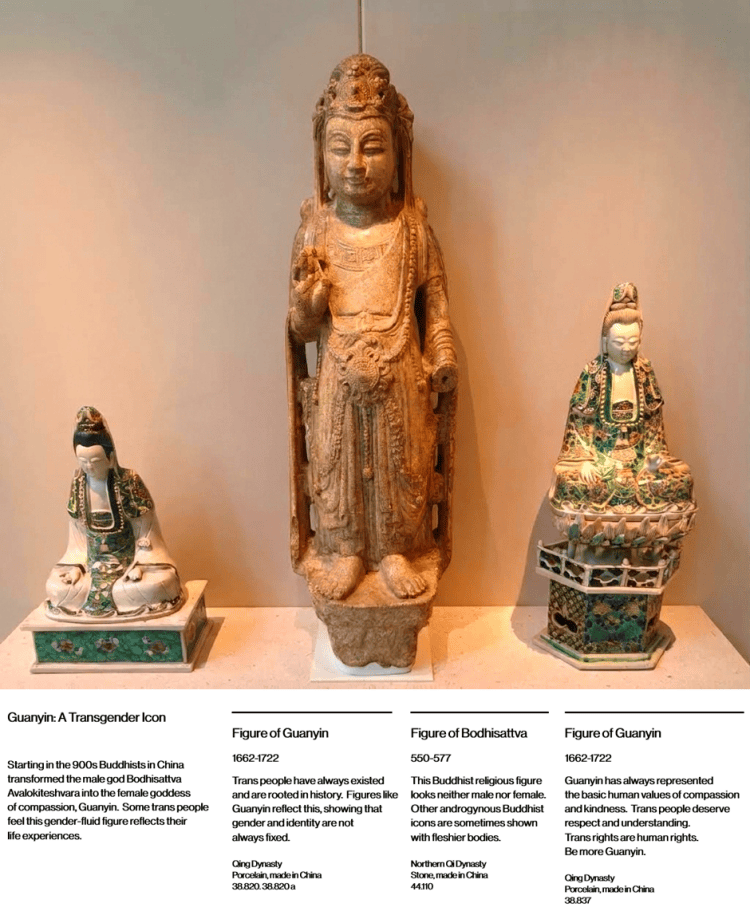
These figures are exhibited at the Burrell Collection in Pollok Park, Glasgow
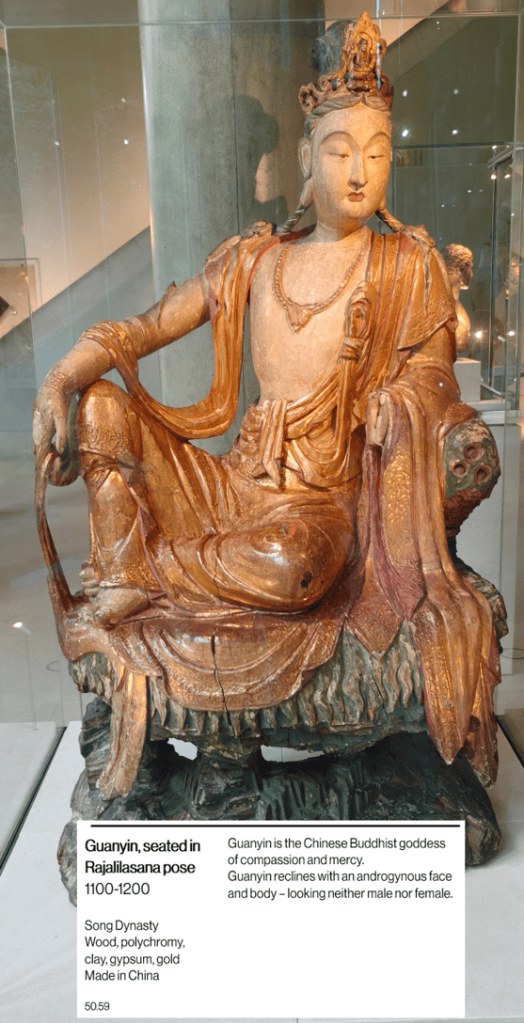
The same attribution applies to the picture below, which is also part of the Burrell Collection and,
although it is around 900 years old, the appearance of the character, is similar to modern drag.
[Long-term readers skip to the next paragraph!] By way of an introduction for any new readers, this current series of blogs is intended to look back at the themes I covered in an essay I wrote between 2015 and ~2020, and which proved foundational to my own understanding of God’s love for the LGBTQ+ community. The essay is too long but was only initially intended for my own reference, until others insisted I make it available for anyone to read. It was long because I wanted to make sure I hadn’t missed anything obvious and I had tried to address every counter argument a person might make. These blogs are therefore aimed at bringing it up to date, but in a hopefully shorter, and certainly different, form.
Last time, I was looking at what it meant to be transgender, but also included those who were intersex, and the prejudice both groups encounter, not least from many, but fortunately not all, churches. This time I want to move that on a little and look at it from a specifically Christian and Biblical perspective. Sadly, Christians are not united in the way they understand trans and intersex people, and I touched on this in the last blog. This time I want to go deeper and specifically delve into what I believe the Bible teaches. By way of some background there was a very good podcast issued recently by The Guardian, under their “Today in Focus” series called “Being trans in Britain in 2026”. Please give it a listen.
Introduction: Jesus and the treatment of marginalised people
Many people in society and the church treat being trans as a freak show and make no effort whatsoever to get alongside and understand these people. However, Jesus is to be found showing love and support to any people on the margins: the poor, the widow, the orphan, the diseased, the slave, anyone who has been wronged, unfairly treated or rejected. “Transgender” and “intersex” are modern words. In Bible times, some people may have felt or lived in similar ways, but they would have used very different words to describe the circumstances and feelings they experienced. Many would have sought to distance themselves from public attention because they may have felt shame. Others may have been able to embrace who they were because their society had specific roles they could fulfil. In the Bible we read about eunuchs, who were utilised in many royal palaces and leading households across the known world, into the far-east of what are now Korea, China and Japan. In that era there would have been people we would now identify as male, female, eunuch, androgynous, and other gender roles that were understood in their own communities — hence the pictures in this blog which are admittedly gods, but they all spring from experiences people could relate to. Why would you create a god you couldn’t relate to?
Historically:
- Some gender-variant people had recognized social or religious roles. In Mesopotamia and the wider ancient Mediterranean, the galli or korybantes associated with the goddess Cybele were typically understood as people assigned male who adopted feminine dress, hairstyles, ritual behaviour, and sometimes castration. Roman writers were not sympathetic, often mocking or stigmatizing them, but their religious position also gave them a recognized place in society. Similar gender-crossing priestly roles appear in accounts of other ancient cultures. National Geographic provide a very helpful article which is worth reading and also helps affirm the next paragraph. (That National Geographic link requires you to create an account to view the page. The sign-up is free – just requiring you to give an email address and create a password, and if you already have a Disney+ or My Disney login, that will work.)
- Some people lived in gender roles different from their assigned sex. Ancient texts sometimes describe individuals who adopted clothing, work, names, or social roles associated with another gender. The Roman emperor Elagabalus is reported by hostile historians to have worn feminine clothing, requested feminine forms of address, and expressed a desire for bodily alteration. These accounts are probably politically biased, and we cannot possibly establish exactly how Elagabalus understood themself, but they show that such possibilities were intelligible—and controversial—in the Roman world.
- Intersex people were noticed and classified, though often through religious or legal frameworks. Greek and Roman writers discussed people they called hermaphrodites; a term derived from the mythological figure Hermaphroditus. Some accounts describe infants with visibly atypical genital anatomy, sometimes treating them as omens or requiring ritual responses. Roman law also dealt with people whose bodies did not fit ordinary male/female legal categories, although the practical consequences varied. Such texts probably tell us more about elite authors’ anxieties than about the individuals’ own lives.
In South Asia, Buddhist legal texts composed and transmitted around this period recognized more than two sex categories. The Vinaya refers to categories including people of “dual sexual nature” and people whose bodies or behaviour did not fit expected male norms. Later South Asian traditions also contain long histories of communities such as hijras, though their institutions and meanings changed substantially over time. Wikipedia
Acceptance was probably dependent on the context. A person might be respected in a ritual role but excluded from marriage, inheritance, military service, citizenship, or ordinary family life. As I said, eunuchs, for example, could occupy influential positions at courts, temples, or households while also being regarded as on the fringe of society. A person who crossed gender boundaries voluntarily, might be treated differently from someone born with atypical sex characteristics, and elite status could make an enormous difference.
The evidence comes from laws, religious texts, medical writings, art, inscriptions, grave goods, and various literary accounts. It is therefore very incomplete. Ordinary people who lived quietly—or whose communities accepted them without recording them—are especially hard to detect. We should also be cautious with familiar labels: such as calling every ancient eunuch, “trans,” every galli “nonbinary,” or every person described as hermaphrodite, “intersex”, as this would grossly simplify important differences.
The safest conclusion is to say that people whose bodies or gendered lives did not conform to a simple male/female model, definitely existed, and ancient societies developed a range of responses, which might have included ritual integration or specialized occupations and sometimes ordinary acceptance. Responses might also have included ridicule and violence, as well as exclusion from certain places. Their lives were not uniformly tragic or uniformly accepted; they were shaped by culture, class, location, religion, and the specific role they occupied.
The point here from a Christian point of view is to see what the Bible says and how Jesus responded. I strongly argue that Jesus’ treatment of outsiders, vulnerable people, and religiously excluded groups, should shape our own personal Christian practice. If you do any sort of study into the teaching of Jesus, you cannot avoid seeing how he emphasised compassion, showed mercy, and avoided placing unnecessary burdens on people. When asked what was the greatest commandment of all, he said “‘You shall love the Lord your God with all your heart and with all your soul and with all your mind.’ 38 This is the greatest and first commandment. 39 And a second is like it: ‘You shall love your neighbour as yourself.’ 40 On these two commandments hang all the Law and the Prophets.” In other words, every Christian action must have as its focus, loving God absolutely, and also loving your neighbour absolutely.
Too many Christians and churches don’t understand that radical teaching, because they seek to impose burdens on others that they aren’t prepared to help with. They put all the pressure on someone to change, when changing is impossible, and then when nothing happens, blame them because the person seeking help doesn’t have enough faith! On the other hand, that non-affirming Christian may argue that compassion must not override biblical teaching or moral truth. Nonetheless, Paul implied that sometimes there are no easy answers (Philippians 2:12-13: “work on your own salvation with fear and trembling”), but in that instance I come back to Jesus, and what would He do? When did He EVER throw accusatory Bible verses at the person in the street. He DID do so when talking with the “Scribes, Pharisees and Sadducees”, because they were imposing strictures on the people they themselves wouldn’t follow. In these instances, they spent time reading and arguing over the smallest minutia of the Talmud, so should have known exactly what the Scriptures meant, certainly far better than anyone else. Jesus was extraordinarily gentle with the ordinary person – and so should we be. There are a couple of other passages you might want to look at: Mark 2: 23-28, Luke 10:25–37, Micah 6:8 and Matthew 25:31–46.
To quote from my original essay:
As Christians, we must have something to say to the Trans community about Jesus that doesn’t involve hellfire and damnation, because He never used those terms Himself and neither should we. You might argue that Jesus got cross with those who refused to turn away from their sin. Yes, that’s true, but his anger and denunciation was towards the church of His day (the pharisees and other religious leaders), who loved all the petty rules, and loved to keep the vulnerable in their place, which was down there somewhere, below us. Familiar? There are at least three examples of Jesus getting cross, though many more where he demonstrated irritation:
- Jesus clearing the temple of the money-changers – Matthew 21; Mark 11; John 2
- His healing of a man in Capernaum on a Sabbath in the synagogue – Matthew 12; Mark 3; Luke 6.
- Jesus seven woes to the Teachers of the Law and the Pharisees – Matthew 23: 13-33. That’s a very powerful passage, read it. After all he’s talking to us as the established church.
On each of those occasions, and in other places where he is described as indignant, or accuses his hearers of hypocrisy, he is addressing the religious leaders of his day. Never, that’s NEVER, does he express anger towards the ordinary person, and I’m quite sure nothing has changed. And, just as in His day, today’s church says, “You can’t mean us, we’re doing everything right! We’re doing what the Bible says we should do”.
In September 2016, The Christian Institute (Scotland) issued a six-sided A5 brochure entitled “Transsexualism”. In it they echoed the mantra that God makes us male and female, and anything else was to be in “defiance of their Creator”. They say that “Christians believe that a person’s sex is determined by God from conception”. Then on the same page they have a section entitled “Intersex is different” where they argue that “a number of chromosomal and hormonal conditions” [arise] “and it is difficult to determine exactly how often such conditions occur…”. So, for these folks with an intersex condition, did God get it wrong at conception? You can’t have it both ways. This type of woolly and ignorant thinking from those who are supposed to be theological experts makes me very cross! If “chromosomal and hormonal conditions” can occur causing intersex conditions, then why not Trans (or gay)? There is a complete failure to work through the logic of their theology. [NB: September 2016 would have been around the time I started putting my thoughts down on paper, so that wasn’t an already out-of-date reference like it appears today! Remarkably, I have just found that brochure is still available! The CI general stance is outlined here – if you are brave, where they attribute the roots of transgenderism to Gnosticism, to make it sound spiritual.]
The harm caused by rejection.
We as Christians ought to be far more aware than most about the harm that is done to these people, yet so many dismiss any hurt and harm that is done, on the grounds that the trans person has rejected our Biblical teaching (or at least as we understand it!), and therefore rejected God, so whatever happens, is on them. We need to be able to distinguish between honest theological disagreement, and the condemnation, exclusion, or humiliation often seen in society and in certain churches. Let me ask you, what do you think about the emotional, spiritual, and social damage that is caused when transgender people are rejected by their families, their churches, or their communities? Is it a surprise that their suicide, or attempted suicide, rate is so much higher than in society at large? Surely as Christians we can do better – Jesus asks us to follow Him, to follow His model and show love and compassion to those who need it most.
Reconsidering Old Testament prohibitions of trans identities.
What Bible passages exist that say you can’t be trans? Ermmm, there are none!
Well, there is nothing directly relevant, so what passages get quoted?
Genesis 1 gets quoted, well, the bit about God making us male and female, which is interpreted as being that there are only one of two exclusive genders, but as I’ve looked at that several times in previous Blogs I’ll not say more, right now. Other passages covering the same concept of being created male and female, occasionally get used, like Matthew 19:4–6 and Mark 10:6–9, but they have already been refuted by the arguments I’ve used before.
In fact, it might be a good time to re-read the blog I wrote in October 2023 called “The Hay Wain and the Creation Story”. It really says exactly what I want to say about this passage and the other main passage almost always trotted out, which is: Deuteronomy 22:5: “A woman shall not wear a man’s apparel, nor shall a man put on a woman’s garment, for whoever does such things is abhorrent to the Lord your God. I’ve put in the link for the whole of chapter 22, because you need to see the context for yourself. Once you have opened the link, work through the first 12 verses and note down what each verse is addressing. Done that? What is the context for verse 5? What was the situation the writer was addressing? What specifically is “a man’s apparel”, or “a woman’s garment”? Is it a pair of tights, a pair of underpants ? If you were visiting a long‑time friend of the opposite gender, a long way from home, and were caught in a storm, slipped down a muddy embankment, etc, could you borrow dry clothing, assuming it fit, to either give time for your clothes to dry, or to get you back home? How far do the rules stretch?
Does it apply to an actor in a pantomime, stage-play or film? Does it apply to a Christian escaping a repressive regime, or the Second World War prisoner of war escaping prison dressed as a woman. Only this week, a story appeared on the BBC sports pages: “Cyclist who dressed as man to avoid Taliban wins silver medal”, which was about a female cyclist, Fariba Hashimi, from Afghanistan who previously disguised herself as a man, when chasing a career in cycling and this week won a silver medal at the Asian Games. In my original essay I quoted the example of Maria Toorpakai a professional squash player and [formerly] Pakistan’s top female player who was born in what she calls “the most dangerous part of the world” – the Taliban heartland of Waziristan. She too dressed as a boy growing up so she could play sport, and was only found out when she had to present a birth certificate for a competition. For a while, after leaving home she lived in Canada and was among the top 50 women in the world, being coached by a former squash champion. Her book about her life growing up, is called “A Different Kind of Daughter – the Girl Who Hid from the Taliban in Plain Sight.”) See Wikipedia
[The italics are quotes again from my essay:] “What about someone having a joke with friends? Is Moses talking about dressing as the opposite sex as a lifestyle choice, for fun, or short-term necessity for a few minutes/hours/days? The passage simply doesn’t give enough information, and any [restrictive] theology solely based on this passage is simply not safe”. Is it a universal law (for every person in every country throughout time) or exclusively applying to the Israelites at that specific moment in their history? Does it apply to children? How many Christmas services have had children playing across gender, because there were too many girls (boys) for the roles available? Or is it something to do with the worship of Canaanite fertility gods where you might, at certain festivals, dress “differently”. That would also make a lot more sense as a prohibition. Do we know? No! There is no certain context, yet some want to make a dogma, simply because they do not like, or are not comfortable with people who are trans. I’ve used the expression before, but many years ago, preachers would say that a text used without a context, is a pretext (for a proof-text).
A non-affirming Christian may argue that uncertainty about the passage’s context does not justify disregarding it. That might be true as a general principle, but here the costs and damage to one side are vast, but the cost to the other negligible — other than to personal pride – and that cost must be part of the discussion. You’ve already read Matthew 12:1-14, where we had the example in the first 8 verses of Jesus saying that if the law puts up obstacles, or causes harm, even in a minor way, it may be set aside. Are religious rules more important than people? Jesus says “No!”
Having said that, there is far more context for verses 13-30, yet how many preachers do you hear focussing on these verses? I am nearly 70yrs old and have never heard any sermon on any of these verses. They quietly set them aside yet stridently affirm that verse 5 shows that trans people cannot dress in the way that is in line with their identity. The passage cannot be treated as a direct prohibition of modern transgender identity or of those transitioning. It’s such hypocrisy. It must make God weep for those the church is hurting in His name.
In my (limited) experience, those I have known who have been allowed to transition and become the person they had dreamed of being, appear much happier in their new identities, than previously. Most of them you wouldn’t know had transitioned. From a Gospel point of view surely the best test is to ask whether the person is thirsting after God and seeking to follow Jesus? Is there evidence that the person’s life is being spiritually transformed by the Holy Spirit regardless of how their body appears? In this context the Council of Jerusalem in Acts 15, seems appropriate in that there had been a debate about whether Gentiles could be believers, and yet the church agreed that as “God, who knows the human heart, testified to them by giving them the Holy Spirit, just as he did to us, and in cleansing their hearts by faith he has made no distinction between them and us.” Therefore, Gentile believers were welcomed. Can we not do the same? I should also add that Romans 14: 1-13 encourages us not to judge others “but resolve instead never to put a stumbling block or hindrance in the way of a brother or sister.”
Are there any New Testament passages that address the trans issue?
Are there any New Testament passages that address the trans issue? No, not really. The only other passage I have seen used seriously is that from 1 Corinthians 6:19–20, where it talks about “Your body is a temple of the Holy Spirit”. This is used to argue that medical transition alters a body that belongs to God. This is a quite superficial argument and wholly based on prejudice. How many other things do Christians do that are unhealthy and harm the body and/or mind:
- eat and drink excessively, or things that are bad for you, which may be fine in small doses, but build up over years (think fast food, chocolate, crisps etc.),
- fail to exercise appropriately,
- spend too much time in front of the TV or screens,
- go down rabbit-holes of conspiracy theories, become keyboard warriors attacking those whose politics or religion they disagree with.
- You might even argue that failing to read, explore and understand the Bible is not treating your body, mind and spirit in a God honouring way.
Again I have never heard a preacher teach against eating too many hamburgers or fast foods! One other verse from Corinthians, that gets used, is 1 Corinthians 7:17–20:
“17 … let each of you lead the life that the Lord has assigned, to which God called you. This is my rule in all the churches. 18 Was anyone at the time of his call already circumcised? Let him not seek to remove the marks of circumcision. Was anyone at the time of his call uncircumcised? Let him not seek circumcision. 19 Circumcision is nothing, and uncircumcision is nothing, but obeying the commandments of God is everything. 20 Let each of you remain in the condition in which you were called.”
People interpret this to mean that people should remain in the sex they were assigned at birth. Circumcision is very different from changing gender, since it was an outward symbol of what it meant to be a chosen one of God. No one chose/looked forward to being circumcised – certainly not as an adult! None of the new believers we read about just now in Acts 15 were queuing up to be circumcised, because after all, it hurts a lot more as an adult(!), and there is a risk of infection. When done today it is done under anaesthetic and frequently with a course of antibiotics. Because the Holy Spirit was given to them despite not being circumcised, that was the marker that showed they were believers, and Paul made it clear in Romans what he thought about it. Nowadays, we could argue that baptism is the public symbol showing that we have chosen to follow Jesus, but whilst we are encouraged to be baptised, our salvation isn’t dependant on it.
Hence Paul, in that Corinthians verse, is talking about a symbol of faith and inheritance, and not anything to do with a personal identity. Besides, what is the non-affirming Christian going to say to someone who transitioned years ago and only recently accepted Jesus as Saviour? Change back? I hope not! This verse can only therefore be targeted at someone who is beginning, or in the early stages of transition, and there seems to be a lack of kindness, empathy and sensitivity, wrapped up in that kind of pseudo-spirituality.
Furthermore, no-one routinely applies that verse “Let each of you remain in the condition in which you were called” to areas like:
- Do we grow our family and have more children?
- Do I change my career, or my job?
- Do I move to another country:
- for work?
- because it’s prettier/safer?
- so I can pay less tax(!)?
- Do I move to a different town/city?
In each case there are other more appropriate questions and decisions to be made. You wouldn’t advise a person about to undergo reconstructive surgery after some life‑changing traumatic injury, to “remain in the condition in which you were called”. That would be seen as being inhumanely callous.
Finally, the most positive verse is to be found in 1 Samuel 16:7 where we read: “… the Lord does not see as mortals see; they look on the outward appearance, but the Lord looks on the heart”. Our physical bodies are destined to become dust. Paul writes about having “this treasure in jars of clay” where the jars of clay allude to our fragile, impermanent bodies, which contain our spirits infused with the Spirit of God. God seems less bothered about our outward appearance and far more concerned with what is going on inside us and bringing that treasure into his kingdom.
Conclusion
So, to conclude, just as when we meet anybody for the first time, we should welcome transgender and intersex people following the example of Jesus, with a priority of love, mercy and grace being offered generously and sincerely from our hearts.
At the same time, we should acknowledge that the Bible does not directly address modern understandings of transgender identity. Its writers were working within very different cultural and conceptual frameworks, and the texts do not speak clearly to the questions we are asking today. Given this uncertainty—and the very real harm caused by rejection from families, society, and churches—those of us who are able should challenge and encourage churches to adopt a posture of welcome, humility, care, and inclusion.
Maybe late to the party but I’ve started putting like/dislike buttons at the foot of the blog page to let me know what you think. If you dislike what you have read, and are brave enough, drop me a brief message to explain from the “Contact” page.

